
Vestige : A book review by Fiona Chamness
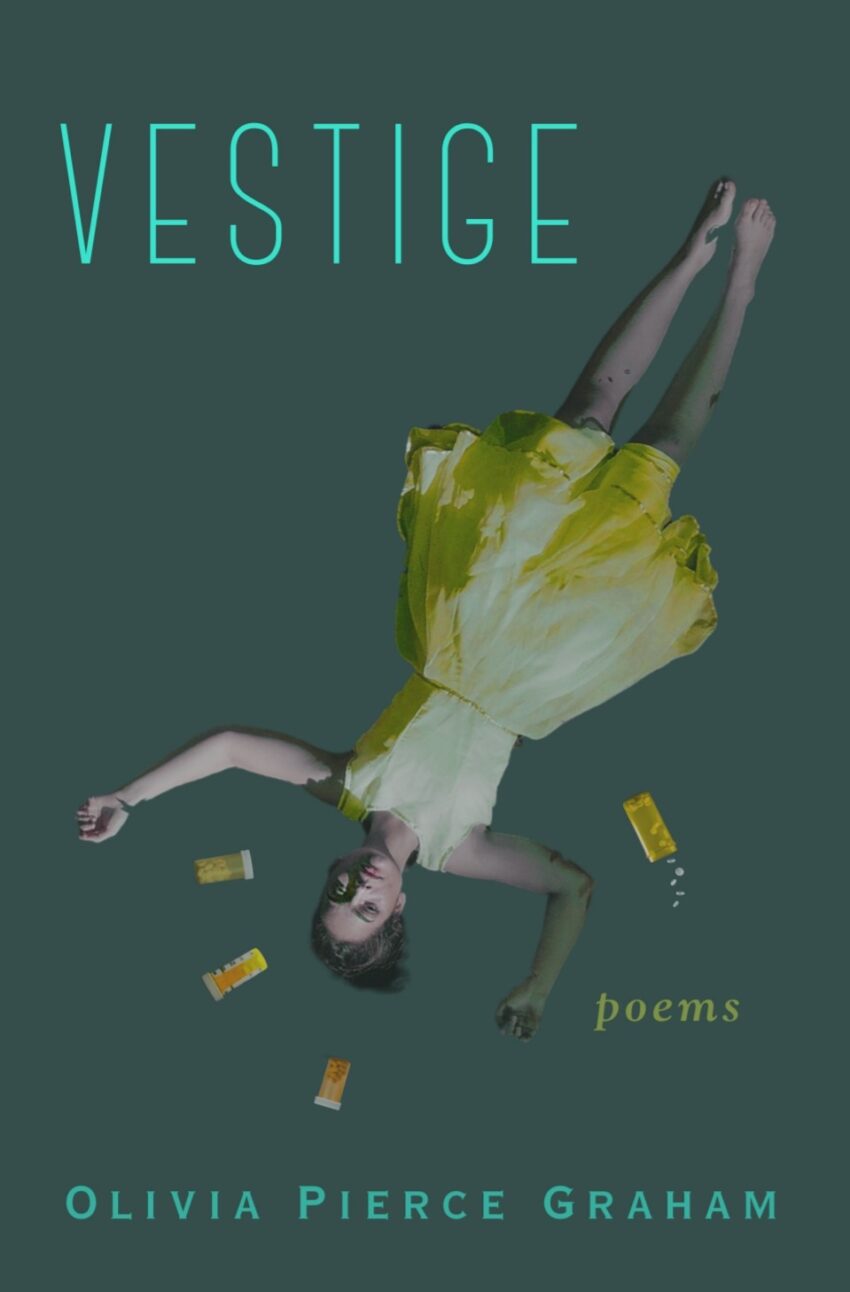
Vestige (Press Pause Press) a poetry collection by Olivia Pierce Graham
One of the asks we most frequently make of poetry is sensory and emotional hyperfidelity. Readers want to dwell, albeit briefly, within the speaker’s experience. Olivia Pierce Graham’s 2026 collection Vestige takes on a valuable challenge in this regard: how does one approach this task when the experience to be imparted is absence? What means can be employed to make readers feel what it is to unfeel, to create a clear sense of fog without clearing the fog itself?
Vestige, an exploration of mental illness and gendered experience that won the Beautiful Pause Prize in 2025, is compact: 30 poems, all less than a page in length. Within that space, Graham offers expansive possibilities for addressing these questions. In “Compartmentalization of Steam,” Graham describes departing the body in response to a sexual advance in a literal steam room: “This is what it feels like / to turn into a ghost. I sit or think I’m sitting. / Condensation slips and sweats until everything/is wet and the same.” The lush alliteration captures the physical setting but also gives the reader a way to feel the disorientation that comes with dissociating. By contrast, in “Exhibition,” Graham writes, “I am back to inhabiting my body, / To calculating the rate of this textured existence.” Here, while embodiment is described, the description feels intentionally abstract. The alliteration is spiky, the words formal; I bounce off the lines, unable to absorb them. Graham uses this strategy throughout the book to disrupt the association between reality and concreteness, unreality and abstraction.
Graham also chooses small moments within poems to make startlingly visceral, indicating the extent of the haze by showing what comes closest to breaking through it. Sometimes, as in “Husband,” we feel the sense of something that is supposed to be making an impression but can’t: “Dripping sweat and morbid fascination, I watch the mosquitoes / Penetrate our fetid flesh and feed.” Other times, as in “Saturday,” we watch overwhelming sensory experience loom, only to be rebuffed at the last moment by simile and introspection: “I’ve learned all about grey matter, how it starts to overflow / from the ears, dripping like some mug somewhere that I never got / to cradle close while walking towards you….” Some poems, like “Dirt,” use white space to muffle the impact of otherwise-vivid language, like trying to throw a punch in a dream:
“every un- explained bruise trembles
with the dew of a cold sweat…”
My favorite poems in the collection interweave these layers of presence and absence so tightly that they capture something I’ve long struggled to describe about dissociative experience: that the world doesn’t vanish, exactly, the senses don’t stop recording; instead, the body turns off its ability to respond to what it registers. Graham’s two contrapuntals, “Wildfire, Still Burning” and “Fair Verona,” her ghazal “Wrists,” and the short poem “Outpatient” do this with exceptional skill. “Fair Verona” and “Wrists” also deftly weave in gender, showing where threat and objectification meet to create both more overwhelm and more distance. Descriptions of being held down physically, emotional disconnect, painfully illustrate the way men’s failure, or refusal, to engage with women’s interiority can estrange women not only from potential partners but also from themselves.
In places, these overarching patterns map uneasily onto individual poems. In “Gleeful Rejection of Object Permanence,” the speaker’s insubstantiality is projected onto fellow airline passengers: “Sitting up straight, facing forward; when I leave here, / they’ll be nothing.” If the book features a dissolving speaker, surely imagining the dissolution of others is fair game too. Yet when taken out of the book’s context, the celebration of forgetting other people ceases to feel like an equal exchange and becomes something more sinister. This reflects, I think, one of the inherent drawbacks of projects that are necessarily laser-focused on one subject’s internal experience – where that subject experiences alienation, their subjectivity erased or made conditional, it’s difficult not to erase others in turn. Occasionally, too, language itself is made self-referential in a way that can feel heavy-handed, breaking the immersion less elegantly than Graham manipulates immersion overall.
Those moments, however, are rare. On the whole, Vestige pulls off a feat, trapping readers in mist, flashing in and out of selfhood. When full flesh and blood returns in the collection’s ferocious closer, “If Your Name Was Ruby,” I found myself sharing its triumph, its anger, and its acceptance. Graham’s work makes delicacy and brutality reflections of one another, peeling layers of consciousness apart to examine them, then confronting us with the consequences of their separation. I am thankful to have read it, and I recommend it to readers ready to be sent, as in “Wildfire, Still Burning,” “Out into the smoke to see / For yourself.”
Fiona Chamness is a writer and musician from Ann Arbor, Michigan. Her work is published in Beloit Poetry Journal, the Indiana Review, Anomaly, and elsewhere, as well as in several anthologies and in the poetry collection Feral Citizens, co-authored with Aimée Lê. She was the recipient of Beloit Poetry Journal’s Chad Walsh Prize in 2014. She holds an MFA in Creative Writing from Rutgers University, Newark. She lives and writes in Baltimore, Maryland.
