One Thousand Origami Paper Cranes Fly Away: A book review by Candice Louisa Daquin
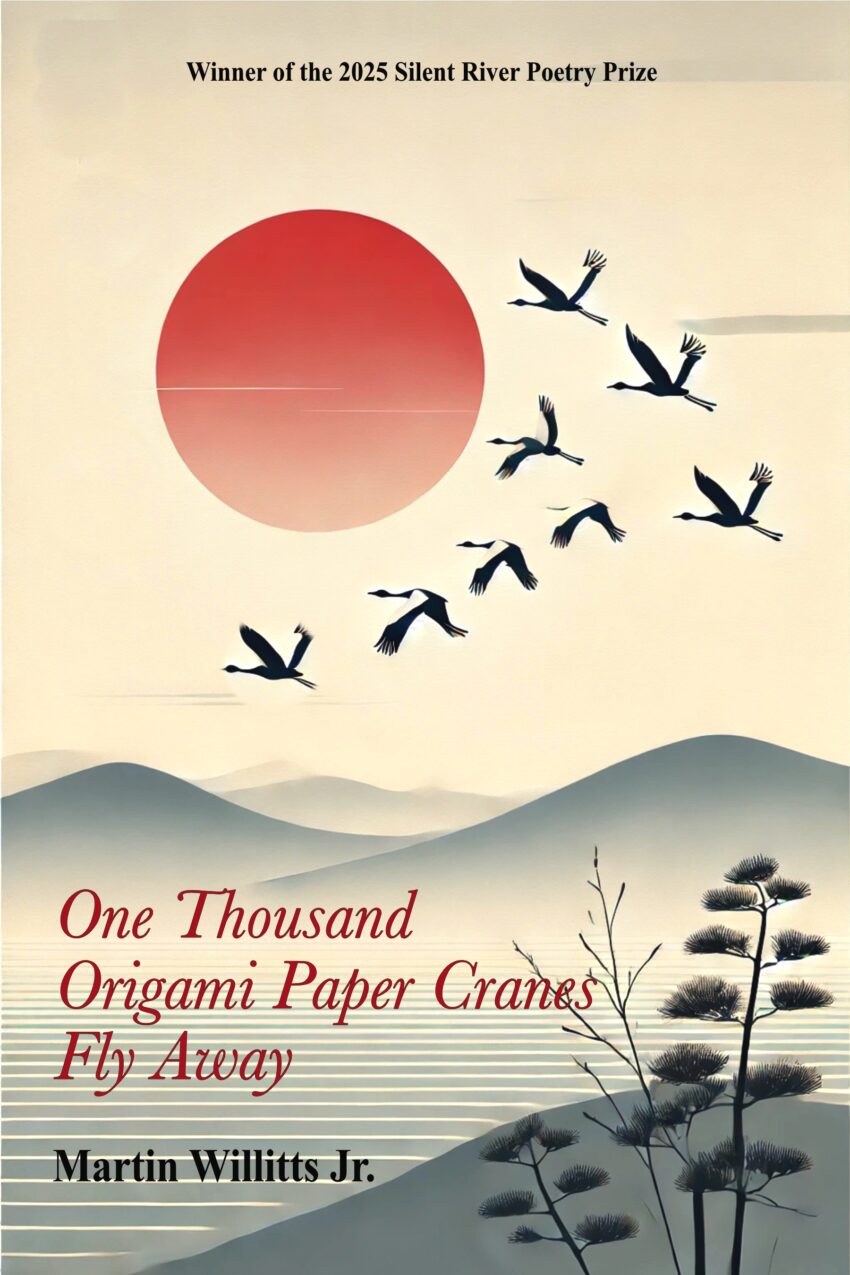
One Thousand Origami Paper Cranes Fly Away (River Paw Press, 2025) a Chapbook by Martin Willitts Jr.
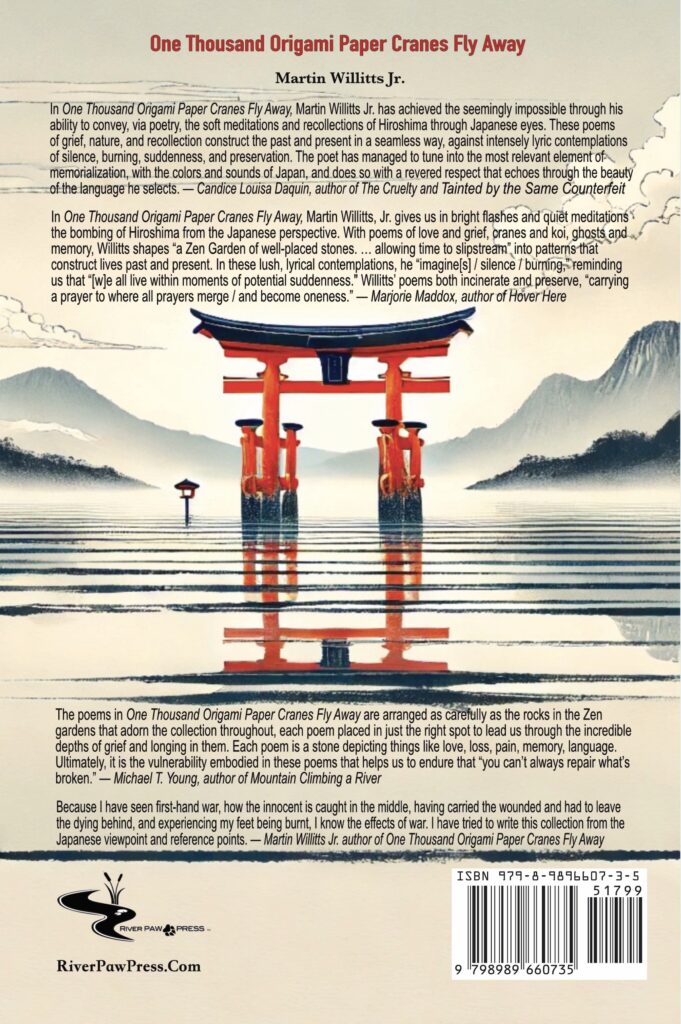
The challenge for a manuscript to shine out from many submissions is seemingly impossible. How does one manuscript stand a chance against many other strong works? In ‘One Thousand Origami Paper Cranes Fly Away,’ Martin Willitts Jr. has achieved the seemingly impossible, through his ability to convey via poetry, the soft meditations and recollections of Hiroshima through Japanese eyes. He is able, by binding his own personal (losses) with a greater sense of loss (the bombing of Japan in WW2 by America) to ask for peace, without getting mired by selfhood, such as the poem ‘A Loss Of Words,’ where the lines: “He left no words; just this loss.” Require no further explanation.”
Immediately there is a connection made between reader and poet, whereby we inhabit Willitts imagined memories of Japan after the bomb dropped, without being enveloped and drowned by the intensity of this horror. This is achieved quite simply by the mastery of language, enabling the nuanced Willitts, to capture the worst, yet reflect it back in a way that is both deeply moving yet somehow bearable. Perhaps because the vantage point is from Japan, this is achieved also in the symbols of ghosts and memory, which are evoked in the Japanese custom, such as the poem ;Constructing Love like an Intentional Japanese Shinto Zen Rock Garden,; where Willitts knowledge of Japanese custom shapes insight:
while allowing time to slipstream takes patience
knowing a pattern will emerge, a Zen thought, (Constructing Love like an Intentional JapaneseShinto Zen Rock Garden)
In the poem ‘Kintsugi’ Willitts writes: “You can’t fix the irreversible.” At the same time his writing attempts this. It is the duality and seeming opposition that sets up a tension for deeper understanding of loss ‘then’ and ‘now and the parallels of both. In the lines: “All the apologizes, all the gold dust holding me / together, cannot contain what’s missing.” The truth and vulnerability of ephemerality is laid stark with a courageous center evidenced in poetic form:
The birds peck at their reasons. She knew this
would happen when she stepped into death
as if it was a wading pool before submerging, (Kintsugi)
These poems of grief, nature and recollection construct the past and present in a seamless way, against intensely lyric contemplations of silence, burning, suddenness, and preservation. Winning a competition with poetry on such a devastating subject, isn’t easy and was achieved by allowing the subject room to breathe, to offer a unique perspective all these years later. Often the most powerful is what is not said, or what is offered in between, than the more stark observations, again a Japanese way of thinking and relating:
there is no difference between
holding a hand and letting it go (Hiroshima)
If someone were to suggest I’d choose as first-place-winner, a collection centered around Hiroshima, I would have been surprised. Once you read Willitts style of writing, it is clearer why his work stood out. He’s a classic poet, with a deep love for Japanese lyricism and structure, able to share the beauty of Japanese poetry whilst describing an atrocity.
This world changes,
people on flame,
some dying in a flash-freeze
shadows on walls,
many will develop cancer. (Hibakusha)
What we learn from a manuscript is often as vital as what we take away. I learned that ‘Hibakusha’ means ‘bomb-affected-person’ and I was glad to be reminded of this time, because if we don’t remember, it gets repeated, if we don’t remember, we don’t continue to evolve, hopefully to the point of rejecting war entirely. Willitts has created such a statement of peace in his writing which aligned so well with the mission behind the poetry prize he entered, Simple? Yes. Challenging. Yes. Like Japanese poets, what appears simplistic, is anything but. The layers of meaning and messages are complex and stay long after reading. It is that deeper message that reveals the real bones of this collection:
I write your name on a paper lantern
to guide your spirit to the other world,
the one without pain or need. (Boat of Names)
There is a very gentle urgency to Willitts writing. He doesn’t push hard, he slowly comes into view, asking questions we should have been asking long before now:
I keep sleepwalking into the future,
wondering what will happen next.
(I Keep Thinking about Photographs of Hiroshima on its Eightieth Anniversary)
After so much time, they have begun to stop teaching the truth of WW1 and 2 in schools. Whole generations will not know what happened, who did what. In order to prevent war, we must understand history and act differently. Willitts is aware of this and in ‘One Thousand Origami Paper Cranes Fly Away Searching for Peace,’ he has managed to tune into the most relevant element of memorialization, with the colors and sounds of Japan and does so with a revered respect that echoes through the beauty of the language he selects:
floating down
the Ōta River
towards the ocean
quiet
and lit
edges
flaking
into ash (Paper Lanterns).
There is also unvarnished grief here; the horror of considering this ‘ash’ is all that is left of people burnt to nothingness. Alongside an intensely Japanese considerations of what ‘nothingness’ is and the reincarnation of nature, fleeting yet meaningful, alongside our fragile human state, and wounds deeper than words can go, where we find despite ourselves, a longing to continue, even as we look back, hoping against the impossible, that we will do better, that we will learn.
Where are the stars tonight?
The cherry blossoms only last three days. (Letters to Emperor Hirohito and Unreturned Responses).
Candice Louisa Daquin is an editor and trauma-therapist. Daquin is Senior Editor with Indie Blu(e) Publishing, Editor with Raw Earth Ink and Queer Ink and editor with Life and Legends, Writers Resist and Tint Journal.