
By Tulasi Acharya
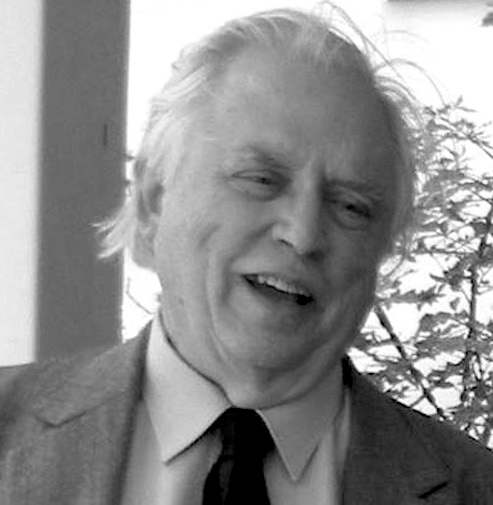
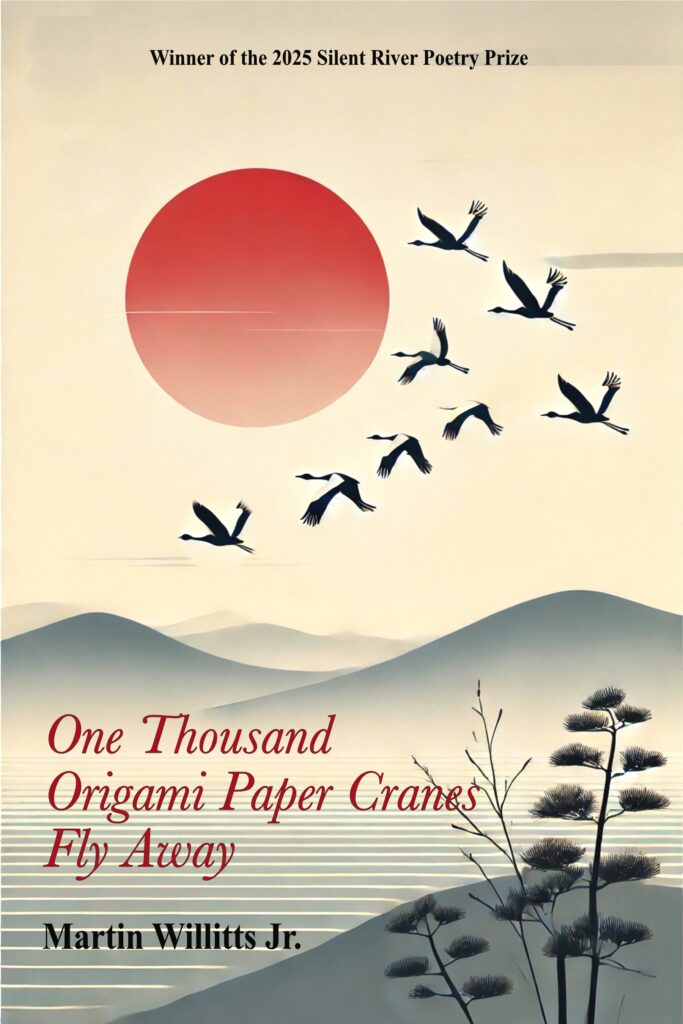
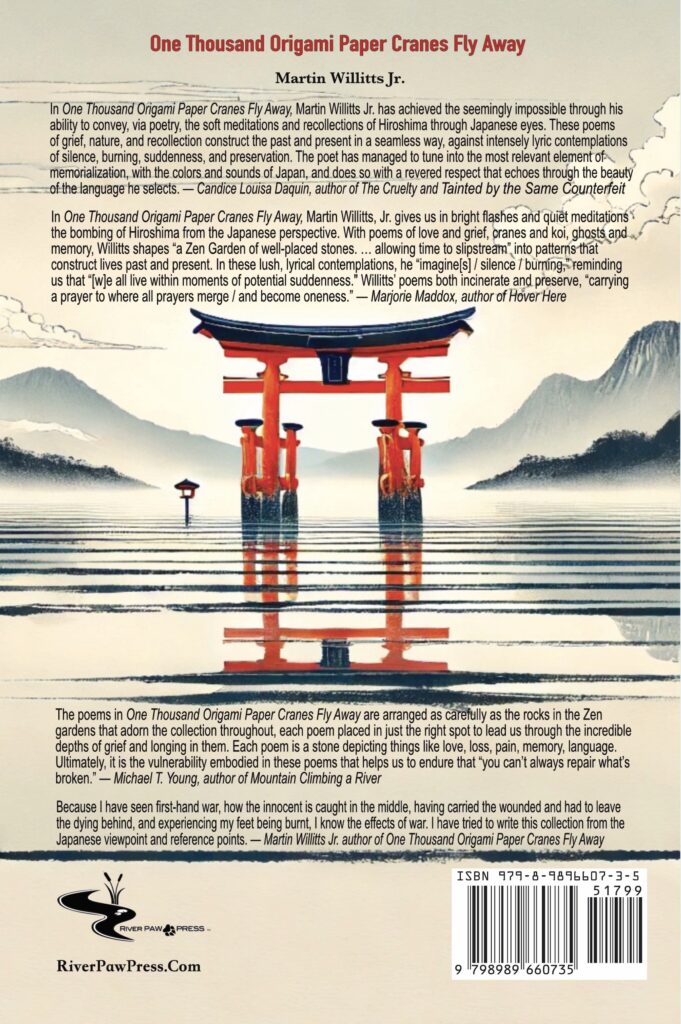
Martin Willitts Jr. is an award-winning poet whose work emerges from a life closely observed and fully lived. The author of over twenty full-length collections and twenty-five chapbooks, he has built a body of work shaped by experience, reflection, and an enduring engagement with history. His most recent chapbook, One Thousand Origami Paper Cranes Fly Away, winner of the 2025 Silent River Poetry Prize by River Paw Press, traces significant moments from his life and career—from his service as a Vietnam War medic to his time in Japan, where he encountered the lingering aftermath of World War II.
In this interview, we explore Martin’s journey of writing One Thousand Origami Paper Cranes Fly Away, his lived experiences and the ways they shape his work. We also discuss his writing process, his approach to craft, and his message for young poets.
TA: Congratulations on being the winner of the 2025 Silent River Poetry Prize. Your poems from One Thousand Origami Paper Cranes Fly Away are contemplative, meditative, and reflective in nature. What role does contemplative meditation play in poetry?
MWJ: Thank you for the congratulations. Asking for a comment about meditation is an interesting starting point. There are too many distractions in this world, pulling us this way and that. We often cannot see what is important. Meditation can help a poet focus on the poem and on revision.
First, focus the mind by deciding what you want to write about as your main subject. For me, the
focus was writing about the bombing of Hiroshima. Then my focus becomes this: why do I want to
write about Hiroshima?
Hiroshima saw many people die. There is a monument about the war called the Hiroshima Peace Memorial Park, a World Heritage Site. It has the Atomic Bomb Dome, one of the bombed buildings at the center, as a reminder that atomic bombs, and now nuclear bombs, are dangerous, deadly, and destructive. It has the Peace Bell, which is embossed with a map of the world without borders. It has the Children’s Peace Monument, built in honor of Sadako Sasaki, who died from leukemia, and whose classmates raised money to build it. The center has the Flame of Peace, an eternal flame that is supposed to burn until all nuclear weapons are removed.
TA: Why did you choose the genre of poetry to write what you wanted to write, despite other genres that could equally and effectively communicate the message you are trying to convey to the world?
MWJ: I do not think I would be a very good fiction writer. I overthink too much. I would question
every chapter, tossing too many pages and throwing it all into a garbage can. I could single-handedly
fill a dump site. If I wrote this as a play, it would probably look a lot like Mother Courage and Her
Children by Bertolt Brecht, written in 1939 as a response to the rise of fascism.
Whatever I might know about poetry arrives from actually printing poetry for major presses and from
reading and owning ten bookcases of small press poetry.
TA: How would you assess yourself as a war survivor and an award-winning poet?
MWJ: On my last day, just before going home, I was severely wounded. I was carrying out a wounded body while under fire when I tripped on a wire. The explosion literally lifted me off my feet. The explosion burned my boots and caused third-degree burns that blackened my feet. I had a choice. I could have both feet amputated, or I could endure having skin grafts removed from my arms and attached to my feet without any painkillers. I chose skin grafts.
I was sent to Japan for rehab. I had to learn all over again how to walk, especially with tender, scarred feet. During this time, I visited Hiroshima, saw the peace center, and saw pictures of Hiroshima, which formed the basis of this collection, One Thousand Origami Paper Cranes Fly Away. If I were to assess myself as a poet, I would say that I am an insecure poet. Since I have never had a poetry writing class, I do not trust my own poetry or images. In spite of awards and publications, I keep questioning myself and my poetry. I work by myself. I wish I had poets who were second readers.
TA: Some of your poems begin with the instant of an incident and later turn into an epiphany. Is that
your conscious choice? If so, why? Or do you have no idea what I am talking about?
MWJ: I think many of my poems work this way. During the first draft, I usually know within two lines the entire format of the poem. Do I want a structured poem with three or four or five lines, or an unstructured poem? Do I want punctuation, or no punctuation? A lot of these poems have no punctuation, so I try to use line breaks as an alternative, and this forces me to focus on narrowing out unnecessary words. I also use a lot of imagery. I am interested in the interconnections of objects, places, people, and nature.
TA: What is love for a poet who witnessed war and also experienced its effects?
MWJ: Love has many meanings and implications. We tend to think of love as passion for another person, but we tend to forget love for family, friends, and strangers. I brought in the North Vietnamese soldiers as well as civilians, American soldiers, and South Vietnamese soldiers. I have seen war’s cruelty firsthand and experienced near-death, plus the pain from severe burns. My first wife died of cancer. This is entirely different from tending to wounded strangers. It becomes personal. You discover how much you really feel about someone when they die. One is subjective; the other is objective.
TA: As a poet, how challenging or enjoyable is it to live in another culture?
MWJ: After I was in Vietnam, I returned to America fluent in Vietnamese. I can still read and write it, but I lost conversational Vietnamese over time. I never lived in Japan long enough to learn the Japanese language, and many Japanese people spoke English. What I learned in Japan was the culture of the Shinto-Buddhist worldview.
TA: In your poem “The Way of the Kami,” you reflect on people’s culture and express a love for
nature that connects to their ancestral past. Tell me about its importance in your poetry.
MWJ: This poem was the first one I wrote in this series. It began with a request to write a poem about
9/11. We had all seen the planes hit the buildings, people leaping to their deaths, and watched as the
buildings imploded. I had a cousin in one of the towers and another cousin in one of the planes. I would like to believe their lives and deaths intersected that day. I thought about Hiroshima and its tragedy. I saw a connection.
This poem is about the Shinto rock gardens, how the placement of stones is intentional, and how the
stones are swept clean daily. The Kami are the spirits of the ancestors and/or anyone in your family who died. The Kami can be displeased if you ignore the care and treatment of the stone garden. You must please the spirits with the placement of the stones and with how much care you provide for them. You must appease the Kami if they are displeased.
TA: “Zen Rock Garden,” “Stone,” “Pebbles,” and Shinto culture are dominant images in your poetry.
Why are you so intrigued by these images?
MWJ: These are all poems about attention to detail. The stones are placed intentionally, considered before placing each stone, and if the stones are disturbed, they will be replaced by chaos and loss. In many ways, they are about my own religious practice of silent worship. This connects two different cultures, two different religions, and two different ways of understanding the importance of silence, meditation, and contemplation. I am seldom writing about one concept, but about many concepts at once, through the way I connect them.
One of the poems uses renga as a structure, combining it with a call and response. One of the Shinto
garden poems uses linked haiku, where one haiku leads into another, like the placement of stones. A
different poem uses three-line stanzas to control the poem and its attempt to eliminate certain words.
Some poems use no punctuation and some use punctuation. What I offer is the many ways of writing
poems. You might call the entire manuscript a form of ars poetica.
TA: In your poem “Kintsugi,” a Japanese Zen term is used, if I am correct, as a healing metaphor. How effective is it to use a cultural metaphor, in particular, to speak of universal themes such as love and peace?
MWJ: This world is very fragile, our lives are fragile, and we seem to edge toward nuclear war. I call
this “brokenness.” The idea of Kintsugi is to fix what is broken and not throw it away. They use a
gold-colored glue substance and a brush to seal cracks or fissures on clay pots, and sometimes glue
together entire shards of pottery.
I was thinking of all the people in Hiroshima who survived the bomb only to get cancer and die later,
as well as my first wife dying of cancer. Poets see connections.
TA: “Hibakusha” is a beautiful poem in your collection that speaks of you. Your voice is so authentic. Would you have realized the effects of war if you had not been wounded in the Vietnam War? How would you assess that as a poet and a war survivor?
MWJ: As poets, we never know what might touch the heart and soul. We write one poem and then move on to the next poem. I am so pleased that this poem touched you.
Hibakusha is a Japanese word that did not exist in the language until the bomb fell. Hibakusha means
“bomb-affected person.” They were the survivors who had cancer afterward. They were ostracized
from society, mistreated, and hated. They were outcasts. No one wanted to be near them, and no one
wanted to marry them.
I make origami. At the peace center, I left a folded origami paper crane at the statue honoring Sadako
Sasaki. She had cancer from the bomb, and when she was in the hospital, she began folding paper cranes. She believed that if she folded one thousand paper cranes, she would be cured. She completed
all one thousand cranes, only to die anyway. I left a paper crane at her statue.
I had a vision of the bomb, its white blinding light, air being sucked out of my lungs, flashes of intense
wind, watching everyone die so fast that only their shadows remained permanently on walls. In psychology, this is called a “gestalt.” Many would call this visionary. Some poets would call this
tapping into the collective unconscious.
During the composition of the manuscript, this was the last poem I wrote. I was not born when the bomb dropped. Sadako died when I was six years old. I had no tangible connection to the bomb except
through my own experiences of surviving a war with an injury.
This poem was written in one draft. It terrified me to think it came so easily. I kept wondering if I should revise it. It was written from the heart. I did not trust the poem. I had to argue with myself to leave it alone, to trust the poem. Poetry contains doubt, and I doubt myself a lot.
TA: Your poems convey a message of peace, love, and making this world a better place to live. Some of the recurring images are paper lanterns and cranes. What is your message to the whole world as a human being, war survivor, and poet?
MWJ: Cranes in Japan symbolize a long-lasting relationship and hope. The cranes mate for life. They
can live together for as many as sixty years. Origami paper crane folding is common in Japan. At the
time I was there, children in third grade knew how to fold origami cranes. In many ways, the crane
represents survival and peace.
Paper lanterns are an easy paper fold. You take a piece of paper, roll it into a cylinder, and make some
holes on the side. There is Tōrō nagashi, a Japanese ceremony during the Bon Festival, where you write a dead person’s name on the paper lantern, place a lit candle in the center of the paper lantern, place it on top of an origami paper boat, and float it down a river. You watch as the paper goes toward the ocean, catching flame. It is similar to cremation. It also reminded me of a Viking funeral. In science, we might call this interconnectedness or quantum entanglement. In poetry, we call it metaphor.
TA: Where were you stationed in Vietnam during your deployment? Did you have any interactions
with local Vietnamese people, and if so, what were those interactions like?
MWJ: My location was right on the border of North and South Vietnam, right in the middle of conflict
and harm. I rescued people at my own risk, always in active fighting, with gunfire and explosions
everywhere. I had lots of contact with the Vietnamese, to the point of becoming fluent in Vietnamese.
My time there was during My Lai, and I was part of that burial detail. It was the most brutal scene:
over three hundred civilians, elderly people, babies, women, and young girls who had been raped.
This kind of incident has happened too often in history.
TA: Please share at least one memory from the Vietnam War that has remained with you as a source of hope for humanity.
MWJ: One time we were conducting a blood transfusion. An American soldier receiving the blood
noticed that the one providing the blood was a North Vietnamese soldier. The American was horrified
and asked why the North Vietnamese soldier was next to him. I simply said, “He’s giving you blood,
or you will risk dying.”
Blood does not know the differences in religion, sex, race, or whether or not they are the enemy. The
only thing blood cares about is a perfect blood-type match. The reason it gives me hope is that the
North Vietnamese soldier offered to donate blood.
TA: As an award-winning poet yourself, what is your message to young poets who want to succeed in their careers as poets?
MWJ: A poet should find a personal way of seeing objects and recording what they see, hear, touch,
taste, and smell. I am an editor for a national print poetry magazine. I see over one thousand poems each issue. We are an independent print magazine, not connected to any college. We have to reject a lot of really good poems. There are two messages in that last paragraph. One message is that rejection is normal; it does not mean you have a terrible poem. The other message is to try sending that same poem to another magazine later. There are thousands of magazines out there. However, if every magazine rejects that poem, it might be a clue. Read lots of poetry. Watch how others put together a poem. Start small with your goals. Do not send to the big magazines right away. Read submission guidelines. If a magazine says it has a theme, do not send a poem that has nothing to do with the theme.
TA: Do you have any final thoughts?
MWJ: This has been a fun experience. I seldom get interviewed. I have reached an age where I would
love to mentor someone. Since I do not have an MFA or doctorate in poetry, I cannot teach poetry.
I hope whatever I have written about the poetry process or how to submit poems has helped. My
collection, One Thousand Origami Paper Cranes Fly Away, is intense, but not all poetry needs to be
so intense. Simply find something you want to write about and write about it.
One Thousand Origami Paper Cranes Fly Away is now available to pre-order.
Martin Willitts Jr. is the author of twenty-four full-length poetry collections, including the National Ecological Award–winning Searching for What You Cannot See (Hiraeth Press, 2013), the Blue Light Award recipient The Temporary World (2019), and his chapbook One Thousand Origami Paper Cranes Fly Away (River Paw Press, 2026), the winner of the 2025 Silent River Poetry Prize.
He is also the winner of the Dylan Thomas International Poetry Contest (2014), the Stephen A. DiBiase Poetry Prize (2018), Editor’s Choice, Rattle Ekphrastic Challenge (December 2020), and the 17th Annual Sejong Writing Competition (2022).
His recent books include Love Never Cools When It Is Hot (Red Wolf Editions, 2025), Martin Willitts Jr.: Selected Poems (FutureCycle Press, 2024), All Beautiful Things Need Not Fly (Silver Bow Press, 2024), The Thirty-Six Views of Mount Fuji (Shanti Arts Press, 2024), Leaving Nothing Behind (Fernwood Press, 2023), Rain Followed Me Home (Glass Lyre Press, 2023), and Ethereal Flowers (Shanti Arts Press, 2023).
Dr. Tulasi Acharya is a Nepali-English writer, academic, and researcher whose work spans both creative and scholarly realms. He is the author of the novel Running from the Dreamland and Sex, Desire, and Taboo in South Asia. Acharya holds a PhD and MFA and teaches English at South Georgia State College and in Nepal. His writing reflects themes of migration, identity, and socio-cultural issues, and he is particularly passionate about exploring marginalized voices in global contexts, gender, and sexuality. Like Water on Leaves of Taro is his most recent memoir. Website: tulasiacharya.com. Twitter/X: @tulsirames
