
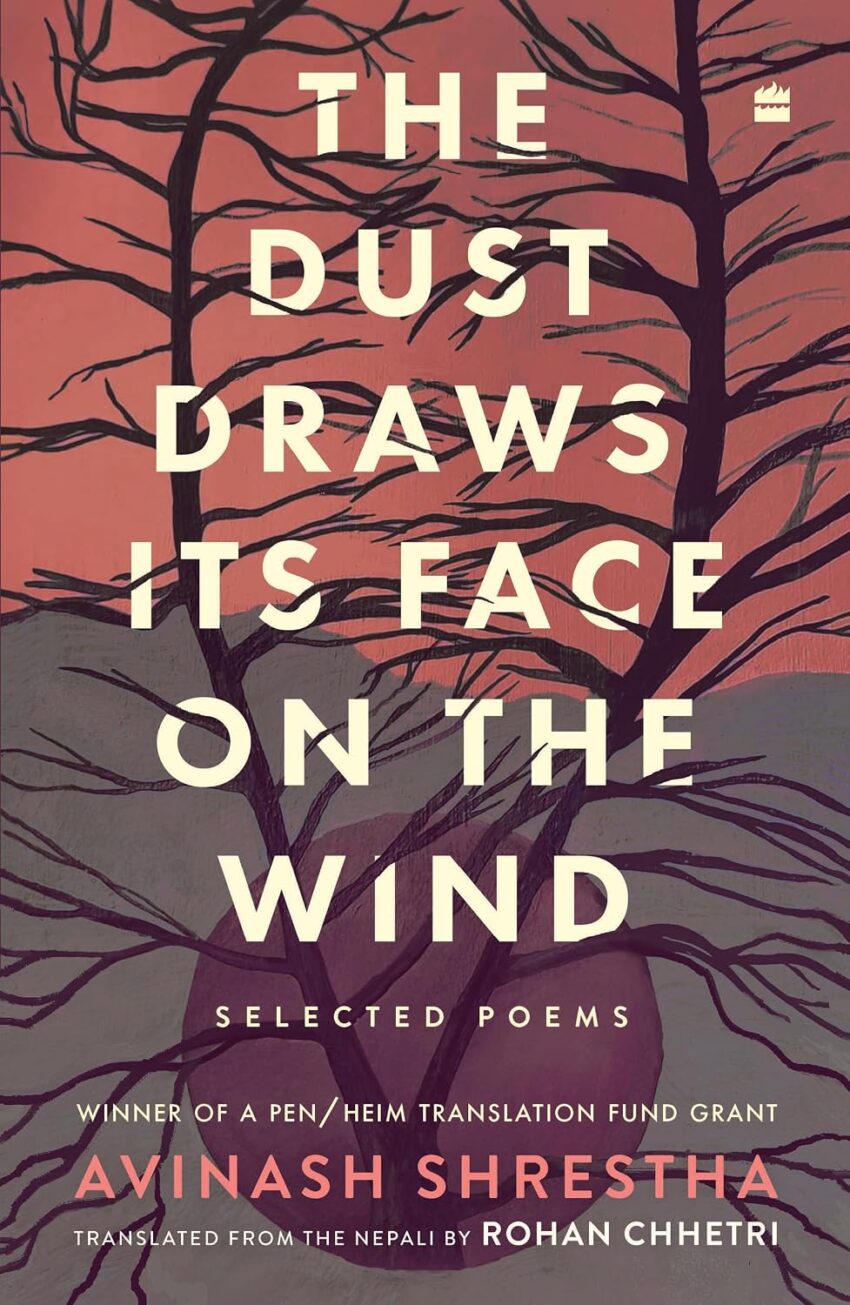
The Dust Draws Its Face on the Wind, a book review by Tulasi Acharya
The Dust Draws Its Face on the Wind (HarperCollins) by Avinash Shrestha Translated by Rohan Chhetri
“Dust Draws its face on the Wind,” a collection of Nepali poems by Avinash Shrestha and their translations by Rohan Chetri, winner of a pen/Heim translation fund grant, brings Englishes into play enhancing the poetry’s expressiveness and confirming their imagery intact.
In “Mother Tongue,” Amy Tan reflects on her realization that writing with the Chinese mother tongue in English makes one’s writing expressive, direct, and full of imagery, which contain more than one English. George Steiner’s “After Babel: Aspects of Language and Translation,” hints at the idea that writing in English— whether in its original form or not—already succumbs to its translation; the process unconsciously begins in the mind. In this context, translation is unavoidable and inevitable. When it comes to the translation of a different language into English, it becomes not only a conscious choice, but also an unconscious contract where two languages, two cultures, two worldviews, two interpretations register. It becomes a playground for a myriad of hermeneutic practices— both a challenge and an opportunity for the translator.
With that said, this translated anthology is a mix of traditional and modern poetry that mulls over people and places, thoughts and emotions, nature and environment, and art and life. Published in both scripts, Nepali, followed by its translation in English side by side, the collection consists of the translations of certain Nepali poems published previously in different poetry books, plus a few new poems, not included in the previous collections. Many dictions in the original poems derive from the Sanskrit language that not only enriches the meaning of each poem but also increases the nuances and the deeper meaning of it, creating a black hole like space in the universe of poetry that sucks in all our concentration and meditative mood. The deep blue ocean of poetry in the collection urges the reader to delve deeper and not return until the gem is found.
In the collection, Chhetri doesn’t let a single poem lose its meaning while working to align with its structure vis-a-visa the original poem in Nepali. Syntax and semantics are flawless; cesura works perfectly fine, and the poem starts where it should start and ends where it should end. One of the amazing and amusing things Chhetri has ever done is his excellent attempt to align with the same number of syllables as he translates, perfectly fitting in the same number of words, in the same structure of the original poems, even including alliteration, assonance, consonance, and internal rhyme. All that remains just immaculate.
In his translation, Chhetri is not only consciously communicating a culture, but also an unconsciously transferring metaphor and its meaning through the scripts and sounds side by side. That is what a good translator does, and that is what a good translation of a good work is. Translated Syntax, semantics, morphemes, and phonemes do such a fine job that hardly gives others any doubt to suspect the authenticity of the translation, not even just by a hair’s breadth.
Usually, one tends to say that the translation is somewhat a submission to the target language, where the source language is hegemonized or colonized, but Chhetri’s forte in this collection is a loud act of bringing expressive language into play. The real work of translation is poetic in the sense that it requires a lot of imagination, knowledge of existing culture, and many other associations that define the culture which comes with language. When it comes to translating a poem, it is more than a poetic dance. It requires a lot of precision, depth, and strong tactile and gustatory sense. It is like a delicate dance on shards of broken glasses, and Chhetri has excelled.
In the poetry, nature image and allegorical pun and fresh idioms resonant like sparks of light as if they are burning coal splintered right out of the ironmaker’s hearth. In “Soulward,” the line goes:
…
Whatever I had to say/was uttered by the river. River/of my heart. In the depths of which/ swim my thoughts’ myriad fish… (121)
Phrases are very poetic and full of imagery and even more expressive when they are translated into English. Poetry with those metaphor creates lightening and thunder followed by a downpour of emotions that gushes into the heart of the reader, flooding their mind and overwhelming them with ideas. In many of Shrestha’s short poems, the translated one goes like this:
Propper up by a gust of wind/I have seen a body of dust/crumble in a second.
I don’t need another’s refuse/The ground beneath is enough for me. (119)
Some of the title in the collection, such as “Metamorphosis,” or “Soliloquy” or “Monologue,” reflects on the narrator’s deeper level of communication with/on nature, ecology, politics, and poverty. Here is a line:
Embracing the river I fall asleep unafraid/&when I wake I become the boundless sea. (9, Metamorphosis)
How do we interpret poetry that is highly charged with emotions and abstraction to speak concrete and full of imageries to speak the abstraction? For example, the poet writes:
“In the desert of the body/grows a cactus.
To prepare oneself against hardness and sterility. (129)
What language game would such poetry create? Reading the poems in the collection propels me to ruminate over such questions. Can dust draw its face on the Wind? Why and when cannot words describe the scene for which again we need words to express how inexpressive it is? Such questions could be difficult to answer even for those poets, postmodern and poststructuralist theorists. Such abstraction, at times, could be the reason why few poems in the collection appear less grounded, which could be the poet’s conscious choice, which requires some mental stretching. And here filling a gap are Shrestha’s poems and Chhetri’s excellent translation for us to ponder.
Dr. Tulasi Acharya is a Nepali-English writer, academic, and researcher whose work spans both creative and scholarly realms. He is the author of the novel Running from the Dreamland and Sex, Desire, and Taboo in South Asia. Acharya holds a PhD and MFA and teaches English at South Georgia State College. His writing reflects themes of migration, identity, and socio-cultural issues, and he is particularly passionate about exploring marginalized voices in global contexts, gender, and sexuality. Like Water on Leaves of Taro is his most recent memoir. Website: www.tulasiacharya.com, Twitter/X: @tulsirames
