
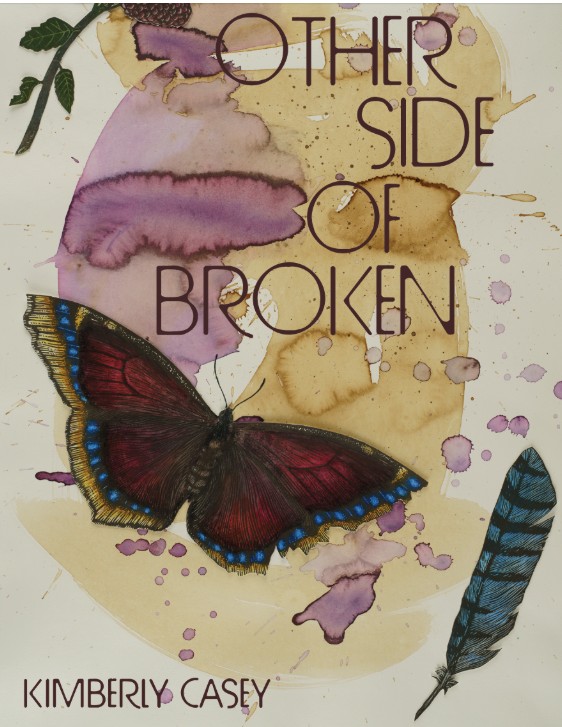
Other Side of Broken, a book review by Candice Louisa Daquin
Other Side of Broken (Riot in Your Throat Press) a poetry collection by Kimberly Casey
With her second collection, Other Side of Broken, Kimberly Casey considers how humans create and then implode and recreate, as we go through life loving, losing and trying to find ourselves. Poignant, urging, necessary questions about who we are, if we are not a mother or a former traditional role and what can be learned from broken relationships, instead of considering them through the lens of regret. It is this incessant, relevant questioning through poetry that ensures Other Side of Broken is ultimately uplifting, redemptive and memorable. In essence, wounds become healing and this is very nuanced and reflective approach is the rhythmic poetic exploration of that process. In the indelible opening poem BROOD we’re plunged into the meat of things with the chanting repeat of ‘I mother’:
I touch my hand to my abdomen
shifting scales under my skin. I blame a bank account,
a body, a history of addiction and mental illness.
But still my womb seeks its own level. I mother
my dogs. My community. My climbing team. I mother
the version of my younger self who still takes control
of the puppet strings of anger from time to time.
The fierce truth and unwavering ripping of scabs in Casey’s poetry is acute in its courage. Poets often tiptoe around hard subjects, never completely revealing themselves. It could be argued; poetry alone is a mask for speaking things otherwise not revealed. Casey takes another approach, she molds poetry to become not just confessional but almost dioramic, a poetic documentary on essential untouched themes like not having children. It’s welcome honesty, without the lacework of earlier confessional poets, who still implement poetic devices to remove themselves directly from the fire. This is direct, cultivated and intentional, somehow beautiful even when necessarily sad:
I am left with the taste of hallelujah on my tongue / Nails
trimmed to the quick / I am digging for the bone of joy (The Dog Speaks)
It is within that beauty, the revealing of honesty alongside, we find why poetry is the ideal vehicle for a poet like Casey, nimble in her wordplay, but not pretentiously aloof or obscure. As a woman who was unable to have children, I may have a differing take on Casey’s perspectives, but when she writes:
Barren is a feared language
perhaps too antiquated for my age.
Call me barn instead, all open doors
unable to keep anything in, (A FEARED LANGUAGE)
I appreciate the immediacy of truth here, applying across varied experiences, connecting disparate lived experiences together in the fierceness of its feminism and out-cry against labeling; sexism, ageism, being without children. It is a reclaiming in a way of language itself, affirming a new season, one of honest reflection without need for apology or prescription. In her poem DANDELION I ached alongside her words:
O tell me how to live with a body
that can’t let go of its seeds
dying
to leave a legacy behind.
It is possible to wish for children, without wanting to be defined by them or condemned for not having them. It is possible to be a feminist having wished for children, but still believing a woman isn’t less-than for not having them. Casey articulates this without having to spell it out, through the finessing of her control of language. In her poem LANDSCAPE, Casey evokes the past and future simultaneously, pulling us into her vivid recollection, whilst holding out a strange hopefulness that feels entirely free of artifice or toxic positivity. One could argue it’s a realistic balancing of the new and old roots and growth:
I leave
the ring among the moss, another totem
for all the ages I’ve ever been,
new roots twisting in with old growth.
Casey’s language is undeniably modern in her betwixt-between life of dogs, smoothies, and other familiar totems. Within those landscapes there lies great revealing, such as in the seemingly innocuous poem LEASH TRAINING, where the vividity and horror blends well with the mundane and familiar:
I never saw myself as a mother. Posed as a midwife for a friend,
sliced through her tough placenta with a serrated blade,
tossed it into the blender to make her a smoothie.
This poetry isn’t so interior that it alienates the reader, nor self-pitying or introspective where we tire of the seeming complaint. The balance here between truthful lived experiences and a longing to climb out of the pit enables the reader to befriend Kimberly Casey through her courage and her weaknesses, which resolve into someone we’d like to know better. Afterall, it is often through tears, humor, horror and minutia that we come to really appreciate and connect with another person:
Age ten, I considered myself a handy woman.
I thought knew my way around tools
and I wanted fix what had been broken. (CIRCUITOUS)
In her final poem REASONS TO BE GRATEFUL FOR FAILING, Casey builds the truth and then lights the match, knowing it will stay imprinted in the canvas of night sky. The messages here are real, they are harrowing, uplifting, and lasting. Surely this is the zenith of any memorable poet, to paint humanities’ lives through their own and then hang the painting where we might consider the universal messages:
To build a family only to watch it
break, to feel that loving again would be impossible
and then doing the impossible anyway.
Candice Louisa Daquin is Associate Editor with Life & Legends, Managing Editor for Lit Fox Books (Austin, TX), Reviews Editor for Austin Poetry Review, and Poetry Editor with Writers Resist and Parcham. Daquin is also Consultant Editor for Raw Earth Ink and co-judge of The Northwind Writing Award. www.candicelouisadaquin.com
