
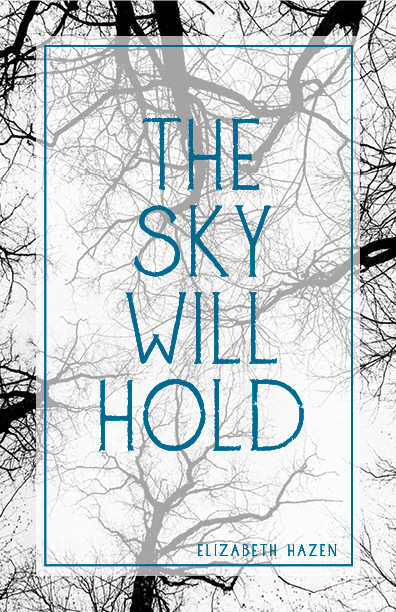
The Sky Will Hold : A book review by Candice Lousisa Daquin
The Sky Will Hold (Riot in Your Throat Press, 2026), a poetry collection by Elizabeth Hazen
Can a woman write simultaneously about the ashen beauty and breakage of living? In her opening poem Approximations, Elizabeth Hazen achieves this, with the lines: “I’ve had it wrong, like when my anger wasn’t / anger, rather fear mixed up with loneliness—” Her questions pierce the sky whilst knowing it will not fall, it will hold.
It is the unvarnished rawness of her poetic voice, the gentle urging of truth that really grabs you here. The questions are not unique to Hazen, they’re not original, yet they stand out because her style is so pared down to what is necessary to know, and the intentional way she does this is startlingly pure in its linguistic truism: “as if any of us get what we deserve— / and if we did, could we live with what we’ve earned?” (Second Marriage).
Poetry can be oblique, sarcastic, referential or uncluttered. Hazen’s writing falls into the latter category, she doesn’t spend time building worlds, she evidences through familiar experiences and a hypnotic, gentling way of speaking: “Back in the car I wanted / to say something redeeming, but you touched / my arm so gently, I was mute.” It is often what is not said, the implication, without obfuscation, left on the emotional table for further inspection, that has the heaviest impact.
Time is a stepmother staking her claim, establishing
boundaries, getting her house in order. Time
is a bully with violent fists; for years I turned
my pockets out for her. (Women at Forty-Five).
Read as a whole, these poems have a thunderclap behind them, such is their emotional resonance, they keep urging and urging until you’re unable to see anything else but the heart of their truth(s) such as in Hell’s Half Acre: “I wish I could / explain my anger, the menace of my dread.”
Hazen wields poetry as a vessel for truth pertaining to existence utilizing artful and exceptionally crafted intentionality, and fierce emotional punch. Unlike less nuanced collections, Hazen doesn’t write for shock value. Her’s is a simmering considered intensity borne of gut-level reflection:
a girl with a loaded gun
trapped inside a woman with her tongue
cut out. (Panic).
When writing doesn’t attempt to woo the reader, but rather, is free to unapologetically be itself, it avoids the tendency toward pretention or self-consciousness. This is language of experience and refusal to quit and evaporate: “The landscape reflects my aging face. / Without apology, I take this space.” (Epiphany in the Badlands). It’s apparent from the first poem to the last, that Hazen’s goal isn’t self-pity, but rather, an examination of women’s lot, the journey of being, what compromises lead to, the hollow letdown of intensity:
the people
we became in public like costumes concealing
our true selves from the world, (Teeth).
The manuscript is intensely visual, triggering our senses as clearly as a film, the language is at times so tender and aching, it’s like a kaleidoscope of bruises you somehow want to touch. Aside from the taut structure and liminal stitching of themes, this is also a photo album of a modern marriage and its myriad disappointments:
I want to warn you: get out while you can.
I want to keep you forever in my burning. (Horses).
However, Hazen doesn’t succumb to maudlin diatribe. Her language is resilient, her anger isn’t restrained, but her language is so artful, at times bewitching through sorrow, that poetry becomes her and the world she shows us, is one many of us recognize. In that shared experience, we find deeper meaning. In Dreaming Sisyphus Happy, Hazen writes: “When I thought the trees were snakes / I wasn’t scared so much as mesmerized.” This fascination with the discovery of things within is the heart of her journey. She doesn’t flinch; she digs in her heels. A modern woman writing of life’s dichotomies and furies, galvanizing us through her own vulnerability and ultimate survival.
Year after year, I am underdressed, uneasy
as an uninvited party guest. I buy
lipsticks that sit in a drawer, little tubes
like shotgun shells. (Whelm).
Candice Louisa Daquin is an editor and trauma-therapist. Daquin is Senior Editor with Indie Blu(e) Publishing, Editor with Raw Earth Ink and Queer Ink and editor with Life and Legends, Writers Resist and Tint Journal.
