
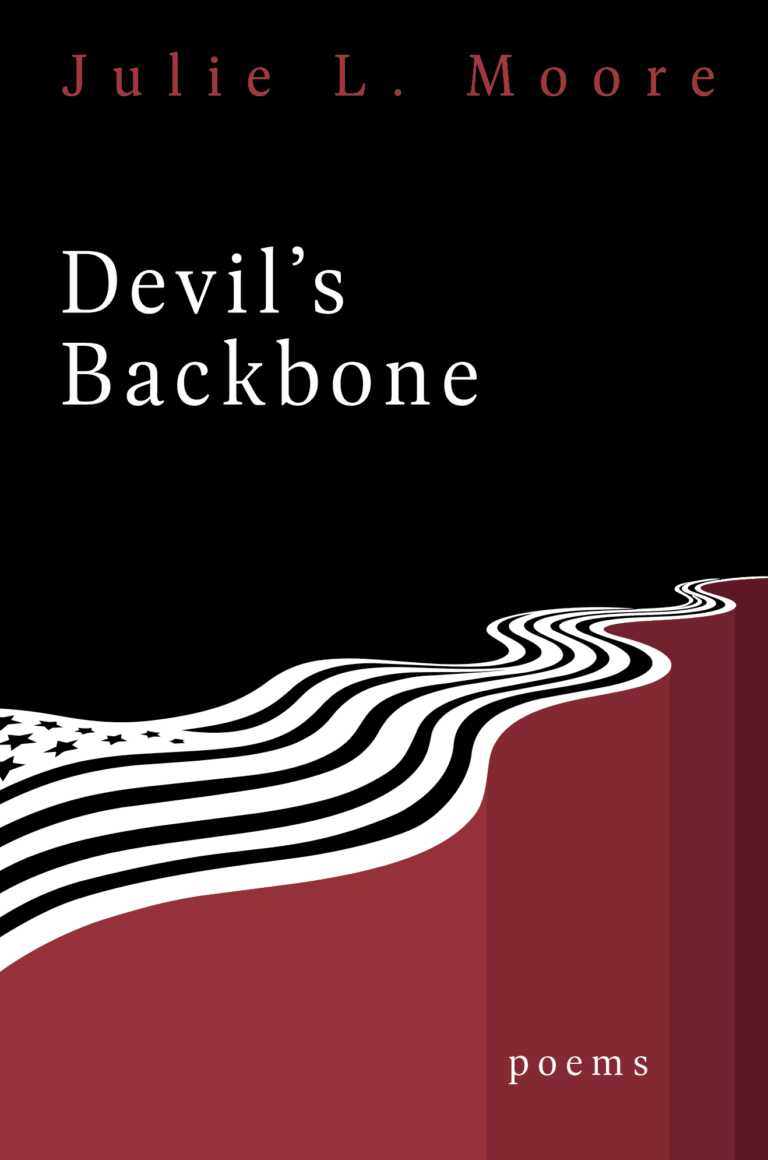
The Devil’s Backbone, a book review by Candice Louisa Daquin
The Devil’s Backbone (Wildhouse Poetry) a poetry collection by Julie L. Moore
Nostalgia is said, can be an illness, in its ability to harness the sufferer to the past. The Devil’s Backbone recognizes such historic snares and by the prolific utilization of epigraphs, forms an alternative. Superficially one can read this as a push-back against colonizer and slaver tyranny, specifically against people of color and women. Given that a white woman writes it, doesn’t ruin the impact this push-back generates with its deep historical insight and determining to use literature to expose and explore against injustice. The anger isn’t unique or as powerful as if it came from a family whose ancestors were enslaved, but nevertheless the breadth of knowledge and its relating to literature makes it a valuable modern asset. That value lies in the minutia of information transmitted, like in ‘The Red that Colored the World’ :
long before Spain came, natives bred the prickly pear
on which the insects fed to bear fewer spines,
so, horse-tail in hand, they could brush the parasites
Is it sufficient to be merely informative? Does it feel appropriative when someone writes outside their own legacy and experiences? The argument goes that white people defending people of color is another way of appropriating the experience, speaking for, drowning out. Whilst I agree, I think there is value in any outrage that seeks to overthrow a dominant paradigm that oppresses others. When we learn through words, we also empower ourselves, so if this is the value of Devi’s Backbone, it possesses enough value to justify its existence in depicting people who were ‘known only by their jobs’ such as the imagined poem ‘Amid Interruptions, Samuel A. Cartwright Pontificates about Drapetomania to a Friend over Fine Dining, New Orleans, June, 1851.’ Whilst it’s fictional, the voice tries to evoke the experience slaved people would have experienced:
Then, then they deceive
themselves into believing liberty affords
something more than the hunger & helplessness
The collection isn’t wholly original or nuanced in a way that sets it apart or startles. There is a predictability to it, as well as in-depth historical consideration, but it is honest. The voice speaks to considerations that were relevant to how others were judged and treated, such as in ‘The Truth about Heaven’ where the speaker says:
This is segregation! Study your Bible.
This truth about Heaven teaches that something is strange and peculiar
about all those who pretend to believe.
Those larger questions will always remain valid. The style and formatting is well honed, this collection has been considered in-depth and that is evidenced in the care of each piece, to convey outrage and rejection of old norms and prejudices, for example in ‘American Diptych’ where the combination of old-language and total disregard to sanctity of life, is mirrored through humorless truism of age-old-racism:
He says he’ll give $100 to anyone who brings
his Black Woman & her well grown hips home
(although we both know she kicks like a colt
when forced to do something
Whether this collection succeeds in the way it would if a person of color had written it or just as a supportive historical outcry against injustice, oppression and prejudice, it does speak to certain experiences by older white American’s, who now question how they were brought up, to include what their parents valued, which seemed harmless, but often wasn’t. In the poem ‘Lone Ranger’ for example:
So by the end, he was neither hireling nor slave.
Oh, how Dad wanted to be him—the cheap
imitation, I mean—& so did every kid I knew,
as we all pretended to be larger than life,
Much like Germans had to contend with at the ends of WW1 and ll, a national sense of shame at (in their case, being aligned with the Nazi’s) some point of history. Can those who benefit from this oppression really speak to it? Or should that be left to people of color, who still struggle with its aftermath (if indeed, it has gone away, which we know it has not). The notes at the end of the collection speak to the writers all-consuming intention to speak up for those whose voices are drowned out. Whether we agree this is the right thing to do or not, the intention appears sincere and hard won. In #Vikinglife there is a palpable sense of understanding backlash and inequity, that anyone can relate to, with lines like: “his body was a flesh-eating target.” This culminates in the closing lines:
sites—when will we learn?—
the more we try to erase, the more we excavate,
laying bare our white-washed tombs full of violence.
Whilst a person of color writing this would put more immediacy and lived truth, there is no doubt this is well intentioned, even if it ultimately comes from a place of privilege. As the author writes in Easter Snow:
Look: these fragile flurries
voice their language in an opalescent
code, which you & I & anyone
can decipher, can know.
Unless it harms BIPOC people to speak of their historic inequity and mistreatment, then whilst it will never possess the same immediacy or fire, the intention of reminding us there is still a long way to go; adds more to the canon of protest, than saying nothing at all. Providing we’re aware, unless it’s our experience or our ancestors, we cannot nor should we ever attempt to claim it or reframe it.
Candice Louisa Daquin is Associate Editor with Life & Legends, Managing Editor for Lit Fox Books (Austin, TX), Reviews Editor for Austin Poetry Review, and Poetry Editor with Writers Resist and Parcham. Daquin is also Consultant Editor for Raw Earth Ink and co-judge of The Northwind Writing Award. www.candicelouisadaquin.com
