
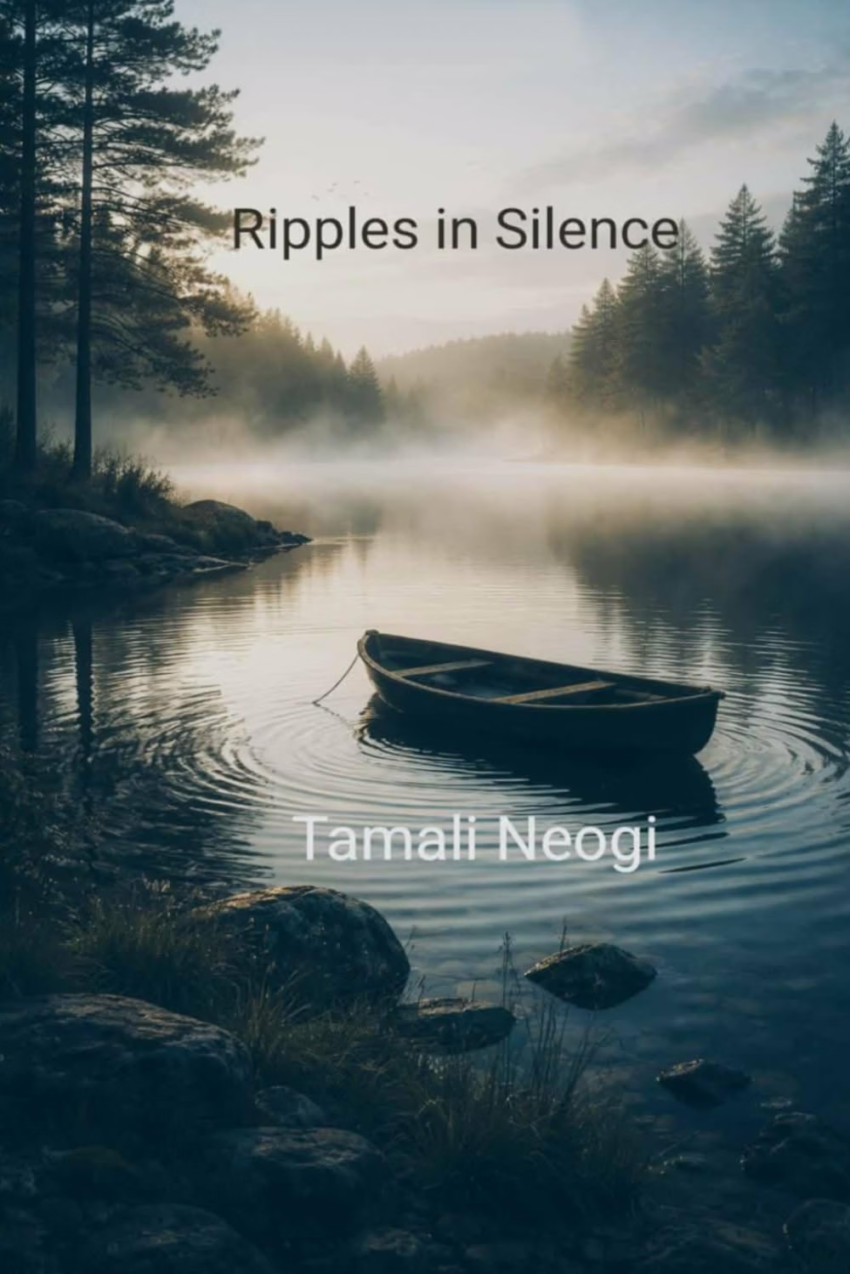
Ripples in Silence, a book review by Candice Louisa Daquin
Ripples in Silence (Transcendent Zero Press) a poetry collection by Tamali Neogi
Poets can hide behind poetry, or they can come flaming through it. In a contemporary literary landscape often cluttered with attempts to meet a trend, or performative wellness, readers may find they are starving for poetry that reckons with the raw weight of being human. Witness then, Tamali Neogi’s Ripples in Silence (published by Transcendent Zero Press).
Given most of us exist in an era of relentless noise, where AI threatens to flatten the creative soul and political polarization causes spiritual exhaustion, poetry can be a palpable solace. If poetry is going to matter is must not pander to solipsism or offer pretty distraction, but instead, act as an instrument of empathy, and soliciting necessary questions that lead to growth:
Why not the dormant volcano in fragile human frames,
but fall if shaken to roots? (True Minds)
Rather than offering a more superficial framework of mysticism or sanitized platitudes, Neogi bravely tackles the maze of human sorrow; our ambiguity in the modern world and the vulnerability of living. What strikes the reader most acutely in reading Ripples in Silence, is Neogi’s piercing gaze and how fiercely she refuses to separate the philosophical from the visceral. It becomes apparent that she understands that human consciousness is never just an abstract cosmic exercise; it carries a real, embodied cost but also the potential for inner work:
our sojourn ordains us not to despair
but hope for the best,
look at the mirror in sheer acceptance. (As Soul to Heart)
Neogi oscillates effortlessly between physiological precision, noting; “the ventricle’s stubborn contract” and the heart’s “wet labour” and its sweeping metaphysical flight. Drawing organically from Buddhist notions of anatta (no-self), Upanishadic dialogue, and Tagorean humanism, she insists that the mind and body must negotiate their mutual wounding. There is nothing romanticized about pain here; instead, there is a bracing honesty about what it costs to stay awake and compassionate in a fractured world. That commitment to naked truth reaches an emotional peak in ‘Light and Shadow,’ where survival itself is rendered through the unflinching physicality of trauma:
When darkness works on me
like poison in entrails,
stabbed spine, broken bones, raped genital left to perish,
I, in half dead’s agony, open my bruised eyes…
There is no voyeurism or exploitation in Neogi’s craft. She doesn’t ask permission to name patriarchal violence; she places the female body directly at the center of personal and societal brutality, demanding we witness what it takes to keep opening our eyes afterward. Like Kamala Das before her, Neogi refuses to soften the edges of female experience or silence the outrage of the marginalized.
Yet what makes Ripples in Silence so compelling and ultimately redemptive, is that Neogi refuses to let despair have the final word. She writes from the rich alluvial soil of Bengali domesticity and global spiritual traditions, weaving intimate family bonds into sharp critiques of modern greed, war, and cultural indifference. Even when examining the quiet, exhausting labor of caregiving and kinship, there is grace and human accountability. She reminds us that we are all vulnerable travelers negotiating an unpredictable fate, yet still capable of tenderness.
Yet, the pain is unbearable, brother.
Let us bathe together (Karna and Arjuna: A Dialogue)
Throughout the book’s seven sections: spanning nature, love, portraits, and conversations with the soul, Neogi is less the lecturing philosopher than a fellow journeyer who has wrestled with the dark and come back bearing light. Her language strips away superficial ego to uncover what endures beneath. Even in our most private, internal reckonings, she shows us that survival refuses to stay silent, leaving a single drop of blood;
rippling outward in the silence of arteries.
The ancient classical poets understood that true verse is pared down to the bone so that silence itself can speak. In our own turbulent century; where noise masquerades as connection and speed replaces depth, Neogi reclaims that sacred rigor, reminding us that silence is not the absence of voice, nor passive surrender. Rather, it is the resonant space where real honesty finally reverberates, where grief is witnessed without shame, and where fragmented souls remember their shared humanity. In an age that constantly pressures us to check out, Tamali Neogi has given us a collection that is fiercely alive, deeply humane, and invigorating in its truths.
Candice Louisa Daquin is a trauma Psychotherapist and editor/writer. She co-edited and created the award-winning anthologies: SMITTEN This Is What Love Looks Like and The Kali Project. Her novel The Cruelty, based on survivorship and Stockholm Syndrome, has won 4 literary prizes so far. Daquin is Managing Editor with Lit Fox Books, Associate Editor for Life and Legends, Poetry Editor at Writers Resist and Reviews Editor with Austin Poetry Review. www.candicelouisadaquin.com
