
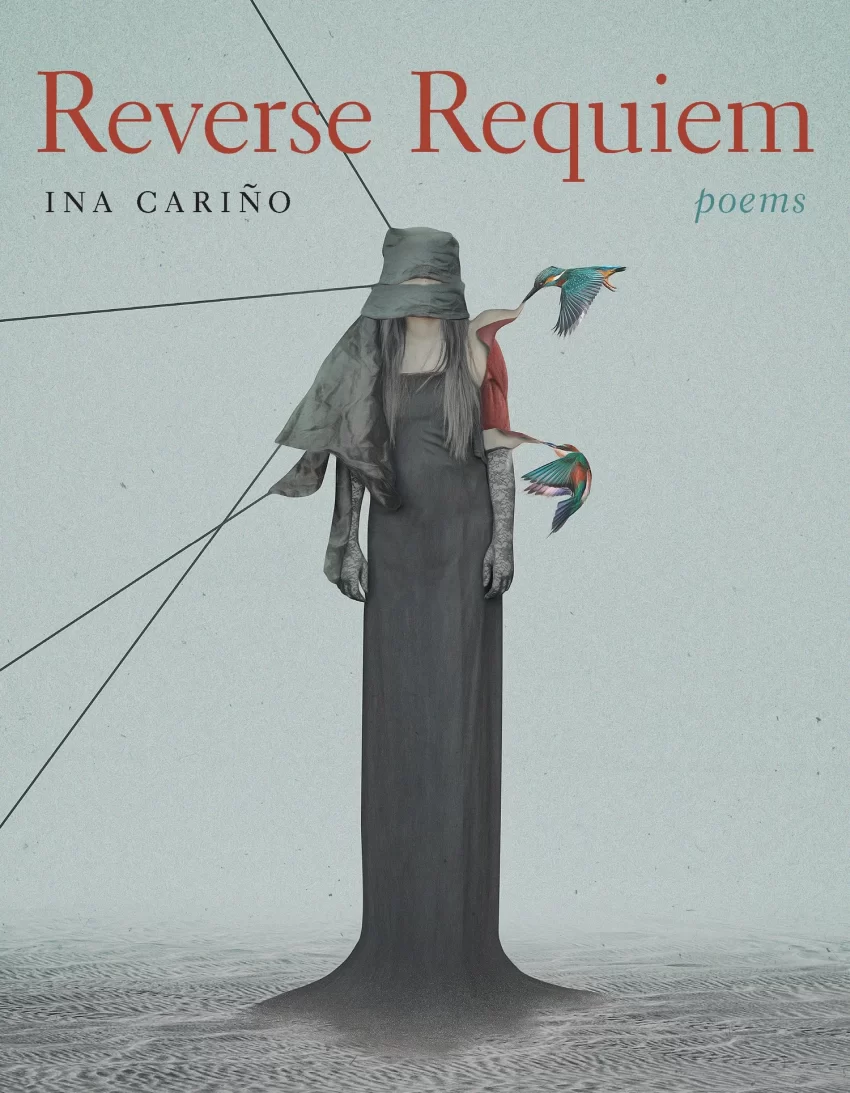
Reverse Requiem: A Book Review by Candice Louisa Daquin
Reverse Requiem (Alice James Books, 2026), a poetry collection by Ina Cariño
Originally from Baguio City in the Philippines, Ina Cariño’s work has appeared in the American Poetry Review, Poetry Magazine and the Paris Review Daily. They are the winner of the 2022 Whiting Award, a Kundiman fellow and winner of the 2021 Alice James Award for their debut Feast. Cariño has also founded a poetry reading series called Indigena Collective. What is most evocative about her writing is the intensity of her lines, tightly packed and redolent with detail and observed time outside the historically white-dominated writing canon, as in her opening poem ‘Native Title’
mashed the letters
together until they resembled my face,
which is as my mother’s – skin of ginger
& violet tuber.
Reverse Requiem, considers what it means to be ‘well’ alongside Cariño’s own scattered ancestry and lineage, set against the modern world’s fitful relationship with connection and alienation poured out in just the right measure with lines like:
still, I’ll gorge myself on the ashes of my
modern-day relics
(As if We are Both Still Children).
Cariño bravely considers the inner dilemma of universal isolation and through their elegiac poems, pulls out the lost meaning of the everyday, interspersing the grief of losing ones original culture and accent, with memories as portal to return back to cherished touchstones:
this germination
of my nonexistent accent.
Written during a year spent immersed in creative disciplines, the music and art Cariño absorbed is evident in Reverse Requiem’s choice of structure and space upon the page, alongside an introspection that despite itself, reaches out to the reader with glimmers of hope. Whether this is emotional risk or personal growth, their writing translates to a retracing of life thus far, through the fractured personal tragedies the poet has experienced, finally to an ending, that despite life’s sharp edges, concluded connection must be the only thing that makes sense.
& I like to clutch my shoulders as if I am loved, as if I am flood
of fire. Still, when my mother’s mothers begin their dance.
(A Wound is a Form of Surrender).
Cariño’s lineage, oft-time ghosts on pages, claim themselves and draw you closer with the essence of truth boldly stated in lines like: “life isn’t long but a decade can be longer.” (Tae). This brutal clarity sweeps the book free of artifice or pretension with its unselfconscious, pared down to the essentials voice:
maybe they meant it when they said I’d hurt someone.
so maybe it was myself, living a vertical sense of space & time. (Dropout).
When we think of the solemnity of poetry and consider how to write grief without thorns or sugar, it must surely be presented as intoxicating as much as sorrowful, whereby you witness death and delight, if the horror is turned just softly down toward an unfurling beauty of language. Few writers unconsciously possess that craft, where intensity and alignment must be gently spoken like pushing words into wet clay, where they vibrate in a song we cannot call grief, but which depicts it so well:
I want to believe you, too,
will still be carrying a box of fruit,
somewhere on this earth, gravity
always pulling us to each other, (Summer Figs)
In the final poem Naming the Silences in the Mouth, there is a deliberate reluctance to structure the English language in a native-speakers way, but rather, transliterate meaning more directly, ensuring the flavors and colors of Cariño’s heritage are never far. In this poem Cariño says: “The one that plugs itself into your lungs when you leave a country for good.” With those simple words, they are speaking for every immigrant who aches in that impossible- to-describe place of no-person’s-land, neither fully acculturated, nor truly able to return ‘home’ and even conceive of home as a stable force. This is evidenced in the long poem Point to Home:
I replicate traumas each time I spend a dollar.
I rummage through the recesses of my bloodline
The aching vestige recollections are set against an alienation and longing, that repeats itself through differing perspectives over four pages, laying out the ways pain persists in the everyday, how the psyche is disassembled and reassembled “untethering from earth” throughout hours, days, weeks, the fragility and impossibility of this and yet, its endurance. When they say “I approximate care from oceans away:” The honesty of that confession, how loss stays in “jewel-green water” alongside a façade of wholeness, is such unvarnished truth, it leaves you breathless, witnessing:
“a history of undoing
at the hands of men who pray.”
Where Cariño doesn’t proffer regret and anger, so much as an acknowledgement, “home is a calling” and for so many immigrants, unable to truly explain to those who have not been displaced in some cultural and physical way, as in their ironic poem Everything is Exactly the Same as it Was the Day Before,
“its whiff a pulse of flint in the dark.” A neglected ghost within the timber of families; “a drumming, / a warning, a spell.”
Candice Louisa Daquin is an editor and trauma-therapist. Daquin is Senior Editor with Indie Blu(e) Publishing, Editor with Raw Earth Ink and Queer Ink and editor with Life and Legends, Writers Resist and Tint Journal.

