
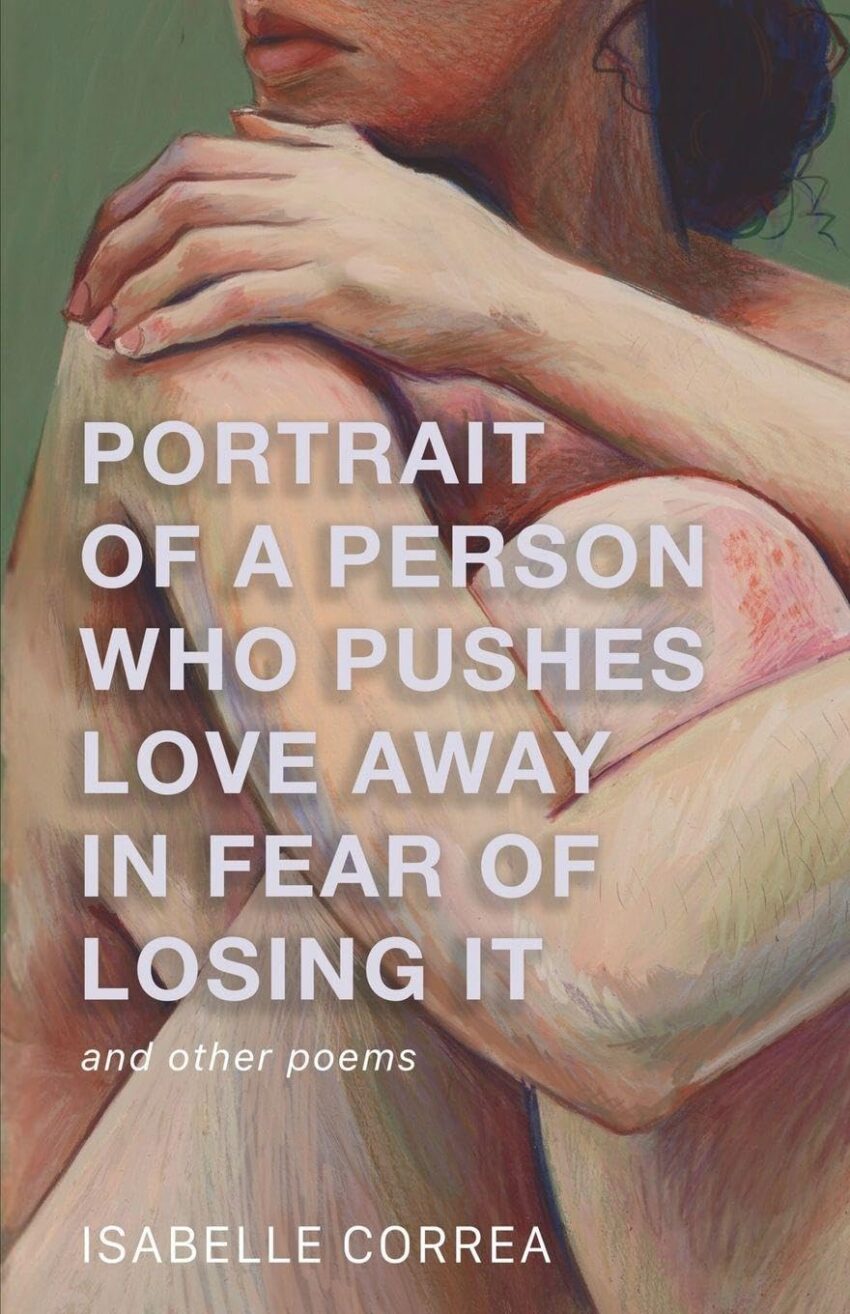
Portrait of a Person Who Pushes Love Away in Fear of Losing It, a book review by Candice Louisa Daquin
Originally from Washington State, now in Mexico City; in Isabelle Correa’s third poetry collection, ‘PORTRAIT OF A PERSON WHO PUSHES LOVE AWAY IN FEAR OF LOSING IT,’ we find a woman unabashed in her antithetical urges, admitting we all resent finding mirrors, even as we seek forms of recognition. In her languaging, she uses extended metaphors to crack open the longing to escape from scrutiny, set against our universal need to count for something:
If my hands
were sparrows If one hand was my father
and the other my mother If I broke
down and told you my every sin
every time I said yes when I meant no (WOULD YOU STILL LOVE ME)
In PORTRAIT, the theme of allowing oneself to be loved, without fearing loss, is advanced, flouting apologies for candor with objective correlation distinguishing the effect of poetic truth from raw truth:
You come home
after walking the city
like an aisle. ([a boy proposes])
It’s gratifying to discover such rhythmic and nuanced allusion within and whilst modern poetry has been shifting to a more curated implied form; PORTRAIT returns redemptively to a purer confessional style, possibly influenced by Correa’s study of Emily Dickinson’s transmutation in poetry of: “Tell the truth but tell it slant.” Correa states in her prologue: “I only exist when somebody loves me” but PORTRAIT is not Plath or Sexton; this is 2026 and Correa as a widely traveled bilingual poet, possesses a considered voice of her own:
Once, I sent a guy nudes because he’d never gotten nudes and he
asked why I looked sad in them.
At the time, I found that ungrateful, but now, I want to know too.
One could argue such honesty only mimicries social media, but this isn’t so. Social media would produce a spectacle. PORTRAIT seeks to understand the underlying lack of fulfillment that permeates modern life; The societal shifts from shame to mania, from exposure to desperately seeking erasure and back again. With her opening poem ‘COMING OF AGE’ we discover Correa’s own transmutative abilities:
When I was a child I was not a child.
I knew about Death, the man
with high cheekbones
who stood over me in my dreams.
I could not move and this aroused him.
The analysis Correa shares about the mechanisms of sickened desire, are so advanced, in considering predators and their motivations. Correa captures the enhanced knowledge of tech-fueled generations who research and come to know the intricacies, for example, of depression and CPTSD, even as there is a price for this awareness:
I stitch them
into one bright voice with the thread of anxiety
and wear their music like a costume dress—
look at me, so human when you touch me. (MY MULTITUDES ARE BACK)
The discombobulation of youth, media, scrutiny, acquisition and its meaninglessness, are enriched by lines like: “Admitting I want / what I shouldn’t” (HOW I SURRENDER) which speak to the dichotomous dissatisfaction of accessing more than ever, but experiencing in that freedom, a pinched, paradoxical lack of meaning and anxious tension:
the hard
work of water, the imperceivable
memory of a forest. I once was
this, I once was that, the gorge,
with her always open arms, (VANTAGE)
The book’s long title recalls Bukowski’s penchant for protracted appellations, minus his intolerableness and some titles like ‘FORGIVE ME / IT’S MY FIRST TIME / HERE /ON EARTH’ are poems themselves, requiring little else. In this poem Correa recognizes: “I am poorly designed / for solitude,” and the epitasis of this charged resonance is:
I ache to be a part.
To be apart.
But I am playing at belonging.
The flickering disconsolation of truth, is located in lines like: “I was born telling lies.” Yet, PORTRAIT doesn’t flinch from rebuking the mistreatment in Correa’s history and demanding transformation; this, very much after Mary Oliver’s penchant for self-healing, nature-infused soliloquys:
Is it working? Are you split open
like a tree by lightning?
Changed by the strange beauty
of simple things? (A STORY TO BREAK YOUR HEART)
Correa pierces the conceit of things so nimbly it’s astonishing. Magical realism a la Louise Glück, against meditative introspectionand its apparent mirror opposite;worldly reflection, work as one to reveal a far larger ancestral history:
The day my grandmother
ferried
deep purple
petunia petals
onto my tongue
like a secret
in reverse—
showing me
how to eat magic
and never starve. (MY MEMORIES NEED ME / TO REMEMBER THEM)
Can anyone write about abuse without falling into the trap of interiority? It is achieved when that writer’s volta and intentionality hinges on truth, not reaction. In the appropriation poem; ‘JUDGE JUDY TEACHES ME ABOUT JUSTICE WHILE MY SISTER SLEEPS IN THE CRAWL SPACE UNDER THE HOUSE,’ the poem it’s disquieting and more horrifying not to be given all the details, but have allusion stand in its place, leading to, if not reconciliation, then fulmination and a centering of selfhood:
The mirror told me to turn into a woman
and I obeyed. No, I have
never been in my right mind. No, I have
everything left to give. (COMING OF AGE)
Candice Louisa Daquin is a psychotherapist and editor. She currently works for Lit Fox Books (Austin TX), Life & Legends, Writers Resist and Austin Poetry Review. Candice’s debut novel ‘The Cruelty’, is an award-winning expose of cruelty and survivorship. www.candicelouisadaquin.com
