
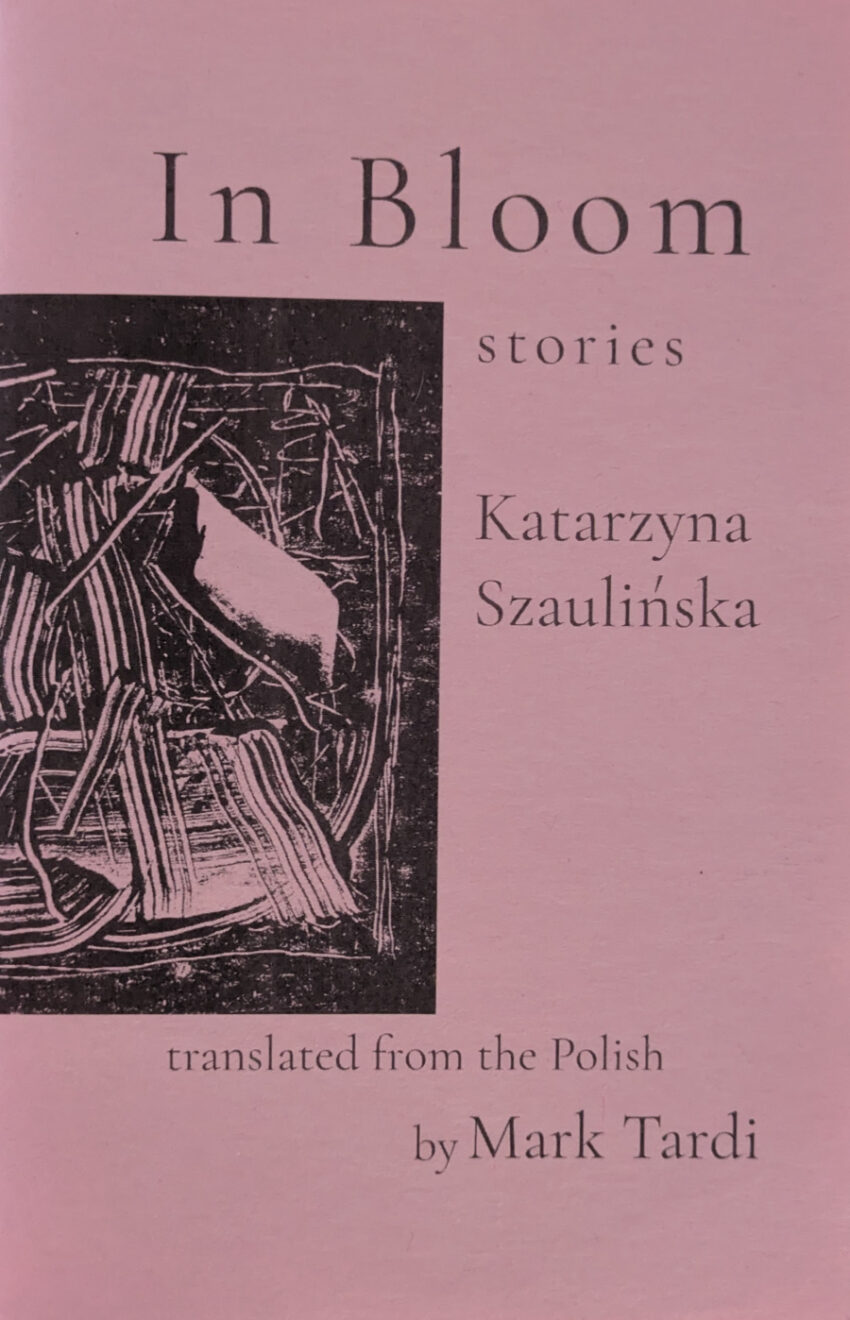
In Bloom, a book review by Candice Louisa Daquin
In Bloom (Toad Press) short stories by Katarzyna Szaulińska (translated by Mark Tardi)
Translator Mark Tardi (accomplished American poet and professor at the University of Łódź) translates Katarzyna Szaulińska’s short stories, ‘In Bloom.’ Published by award-winning Toad Press, who solely publish works in translation, this chapbook feels like the translator picks up on cultural and dialectical nuance, which is often challenging, regardless of fluency. In the eponymous ‘In Bloom’ the focus is on transformation, specifically biological and physical. Utilizing surrealism, Szaulińska considers what would happen if people found flowers growing out of their bodies? It is a larger allegory to humanities consideration of themselves in relation to others, especially in our navigation around relationships. At the same time there is a significant relevance to autonomy of selfhood, what our physical ‘selves’ really represent in an increasingly technology-reliant world.
These four tales contemplate humanities shifting, oft imperfect boundaries, examining how psychology plays a part in our ability to transform, asking the question, do we also transform through more surrealist means? As a psychiatrist, Szaulińska’s career has permitted her writing to evolve from speculative, to informed. At the same time, she runs with the tradition of almost auto writing her way through a surrealist landscape, to explore a dreamscape that extends beyond the literal.
In the story ‘Online’ this consideration of connection in a modern world, is reexamined; specifically choosing to look at what happens when you move the therapeutic relationship to an online platform and in general, how human relationships alter when they are through technology. This is a subject that’s been talked about exhaustively in the psychotherapy world, but less so in fiction. By employing fiction, arguments can be made without fact checking, enabling a real dialogue about what is ‘real’ to flourish (or bloom).
In Szaulińska’s third story ‘Bedfellows’ the title speaks to the uncovering of our boundaries and intimacies; what does it mean to become attached to another person? Physically? In relation to the previous story, there’s a progression of thought from our potential for disconnection through technology, to the challenges of literal and physical closeness in who we select and why.
In the final story in the small collection, entitled ‘Degesch Blues,’ we ponder humanities’ ability to twist things psychologically. Here we contemplate the outcomes of our anxieties, in relation to our whole, and the impact one person has on that whole. It’s a very nicely considered quartet of short stories because one naturally leads to the other, but all can be contemplated separately.
In terms of major themes; Szaulińska’s emphasis lingers on the indistinct boundaries between humans. Critics have consistently noted how Szaulińska’s writing considers concepts of sanity, on a continuum. As a practitioner myself, I found I could relate and read between the lines as to Szaulińska’s anxieties around patient-doctor boundaries and the fragility of thinking we can label or understand others. This is medical surrealism’s hook, perhaps beginning with André Breton, the official ‘founder’ of surrealism, to the literary device of ‘automatic writing’ (meaning without filter or unconsciously). Some argue JG Ballard’s ‘The Crystal World’ was the first English-language medical surrealist novel. French writers like Marie Darrieussecq, blend speculative science fiction alongside medical surrealism and like Szaulińska, Darrieussecq was professionally trained in the psychological field, possibly influencing her proclivity for the corporal-based and oft visceral novels like her ‘Notre vie dans les forêts’. What’s most apparent, are the lack of rules in this reality, instead Szaulińska’s protagonists evoke their inner mental conflicts through physical expression. I liken this to an exaggerated link between mind/body/spirit.
As with any surrealist direction, Szaulińska’s unique form can be challenging, hence the importance of a confident translation. When contemplating ‘In Bloom’ in relation to its Polish version, the importance of retaining narrative voice and the deliberate broken rules of surrealism, presented an additional challenge. Since Szaulińska doesn’t write to expectation, but rather, refuses traditional storytelling, her narrative voice is free of trope and thus, able to be translated through a marriage of imagination and creativity, where Tardi must inhabit that world in his own expression as translator.
Fluidity is harder to translate literally because it is not literal. Szaulińska’s complex examination of the human mind attempts boundlessness, and Tardi shares her belief that boundaries are less useful than what we experience. It’s not whether we are sane, but what definition means and in what context? The same with reality versus hallucination; in the vein of surrealist writers like German Unica Zürn (Dark Spring) and Egyptian Joyce Mansour (Torn Tears) the point is to possess a point whilst eliminating established definitions.
To achieve this, Szaulińska’s style like others, requires degrees of surprise and measures of absurdity, because in that unpredictability, there is another kind of insight; such as the apparent manifestation of a growing flower from one’s body. Translator Tardi, adapted Szaulińska’s unique style in two of her books by sharing a love of experimental language and resistance to convention. Specifically, Tardi doesn’t reduce the linguistic friction; instead inhabiting Szaulińska’s tone which rejects smoothness, employing specific verbs that ‘mirror’ their impact in Polish, when describing physicality.
‘In Bloom’ successfully melds the corporal (body) and cognitive (mind) resulting in a deliberately fragmented experience. The nod to disorientation and even, an intentional deconstruction of linear thinking, enables readers to experience ‘In Bloom’ through a different state of being, where feeling comes from how Szaulińska personifies language.
Candice Louisa Daquin is a psychotherapist and editor. She currently works for Lit Fox Books (Austin TX), Life & Legends, Writers Resist and Austin Poetry Review. Candice’s debut novel ‘The Cruelty’, is an award-winning expose of cruelty and survivorship. www.candicelouisadaquin.com
