
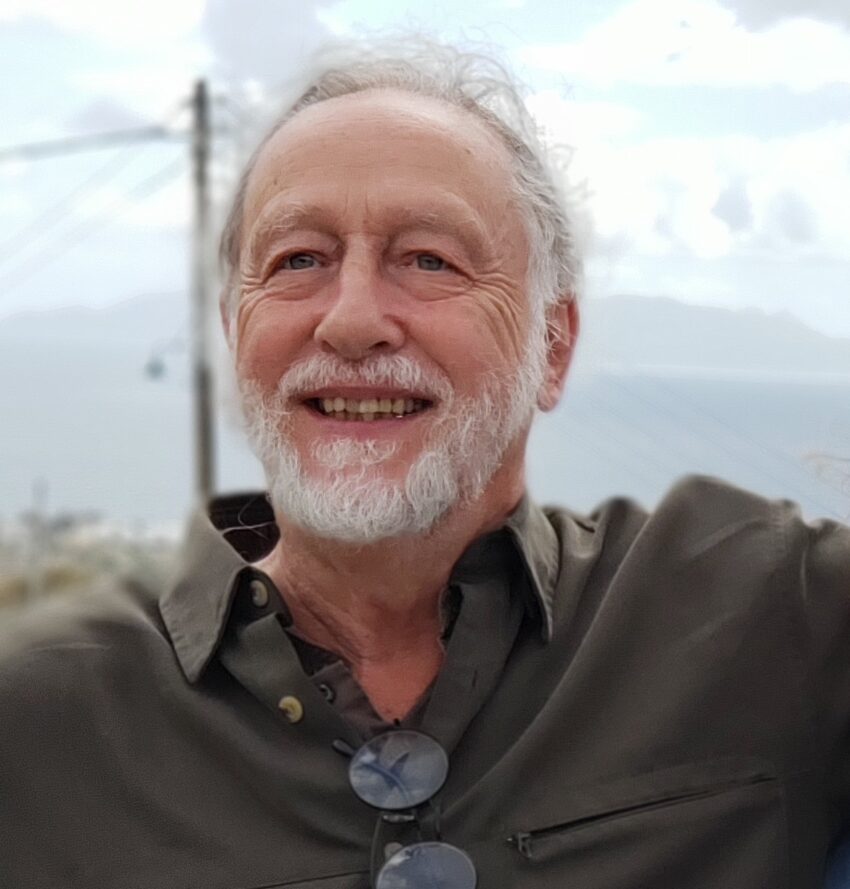
Ed Ruzicka is an accomplished American poet who currently serves as president of the Poetry Society of Louisiana. Raised in a small Midwestern town not far from Chicago, Ruzicka spent his professional life as an occupational therapist and now lives with his wife in Baton Rouge, Louisiana, where poetry remains central to his creative life. His work has appeared in Atlanta Review, Chicago Literati, Rattle, Canary, and numerous other literary magazines and anthologies, and he has been nominated three times for the Pushcart Prize, as well as named a runner-up and shortlisted in numerous literary contests. His fifth full-length collection, The Invention of Dreams, was released in the spring of 2026. Most recently, his chapbook The Language of Wind Over Water was selected as the winner of the 2026 Silent River Poetry Prize.
The Language of Wind Over Water is a contemplative collection that explores the human spirit, consciousness, impermanence, and our relationship with the living world. Set against the water and marshes of the Louisiana bayous, the book is written from Ruzicka’s attentive observation of the lives and silent world of egrets. Through these moments of attention, the poet transforms observation into meditation and reflection on our shared human experience, revealing a deep interconnectedness between the human spirit and the natural world.
As the judge who selected The Language of Wind Over Water for the Silent River Poetry Prize, I was fascinated by its contemplative vision, luminous poetic language, and profound exploration of consciousness and the nature of impermanence in all that exists. The collection carries profound wisdom and emotional depth, inviting us to experience life with greater awareness, compassion, and wonder. In this conversation for Life and Legends, I speak with Ed Ruzicka about the poetry behind this remarkable collection, the landscapes and experiences that shaped it, and the larger questions of life, attention, and human connection that continue to inform his work.
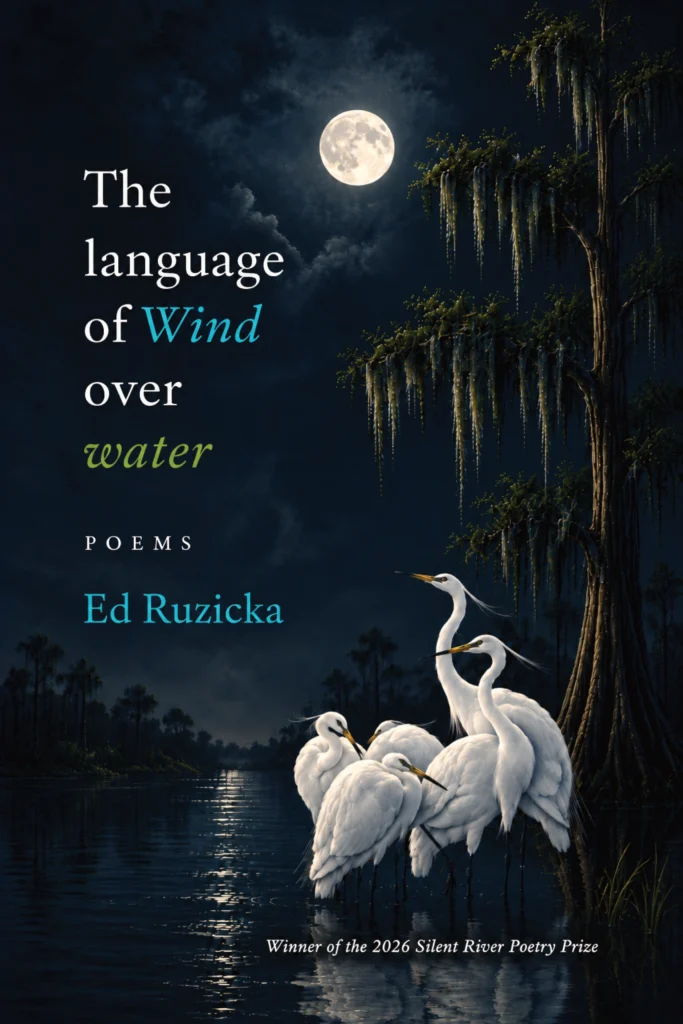
Kalpna Singh-Chitnis (KSC): Ed, congratulations on winning the 2026 Silent River Poetry Prize for your chapbook The Language of Wind Over Water, and welcome to Life and Legends. To begin with, please share what this collection means to you and what you hope readers will carry with them after reading it.
Ed Ruzicka (ER): A couple of things. A few years ago, I was just a dude who loved nature and tried to put my observations down in words. Then, after reading some of the poet David Chorlton’s works, I began to delve into my own thoughts, spirit-shifts, emotions and reactions and to include a deeper and more penetrating account of nature and how we interact with nature. I started to investigate the myths that live within every creature and natural force. Egrets became a way to do that. I hope that readers come in vivid contact with the intersection of the spirit world and the natural world.
KSC: How did The Language of Wind Over Water come into being? Were these poems conceived as a collection from the beginning, or did you gradually discover that individual poems were becoming part of a larger conversation?
ER: I wrote a few poems trying to capture the grace of egrets. Maybe I had three of those – just nature poems, really. Out of the blue one morning a new way of seeing the egret moved in me. After I came upon egrets as passageways into a larger, more diverse universe, more poems started to germinate. I became aware that I might have enough for a book once I tapped this notion of egrets as passageways. Poems started to flow from my fingers.
KSC: The egret is a recurring presence throughout the collection, yet the poems move far beyond the bird itself into love, mortality, consciousness, memory, and our relationship with the world around us. Why did the egret become the central presence through which you wanted to explore these larger questions?
ER: Why? Hmmm, that is always a hard one. I am not a poet who writes with preconceived ideas. I take what is given and try to understand that. The egret quickly morphed into myth. I followed its flight.
KSC: Were these poems born from actually spending time observing egrets and the Louisiana landscape, or did the birds become more imaginative and their presence more symbolic as you wrote? Tell us about the relationship between observation and imagination in creating this book.
ER: I spend a good deal of time on the water. Louisiana is about paddles and boats in the way that Colorado is about boots and a hiking stick. Egrets are fairly common here and as graceful as lyres. One looks long and hard. When one is out alone in the Atchafalaya Basin and begins to understand how primordial a swamp is, other mythic elements begin to present themselves: whiteness as an absence, constellations reflected on still water as a doorway, death and rebirth. I guess that the egret’s relation to femininity came late. All of it, the swamps, the birds, is a way to talk about spirit and how Godliness breathes around each day, even in the least of things.
KSC: Your experience with Zen practice seems particularly relevant to a collection so attentive to stillness, impermanence, presence, and the boundaries between the self and the world. How, if at all, has your Zen practice shaped the way you see these birds and the way you write about them?
ER: This is an interesting question. When I was in my twenties I was a Zen hound. I was in the Midwest, so that just meant reading books and texts. Zen was just starting to be a thing in America. I learned to meditate. I see and saw Zen as a way of letting go of presuppositions so that one can have direct contact with the world. I hope that is in this book. Wittgenstein famously says something to the effect of “that which one cannot speak, one should not speak.” In other words, respect the wholeness of the universe, which can never be grasped through language. In “The Language of Wind Over Water” I tried to speak about the things that I do know so that the luminous universe shines through. I work hard at language, not just how the sounds flow together, but what lives beyond words’ limits. That was especially important for me with this group of poems.
KSC: Some of your poems suggest that observation can lead beyond the visible world, as in “Egret in Facets.” When you are writing, how often does something physically observed become an entrance into something inward, spiritual, or metaphysical?
ER: Daily. I have gotten fairly prolific, and the process of moving between the physical and the spiritual planes is essentially my way. Physicists conjecture that we live on many planes at once. I work with that sort of awareness as much as I can.
KSC: Silence has an extraordinary presence throughout The Language of Wind Over Water. What does silence make possible for you as a poet that language cannot?
ER: Silence for me is the removal of self so that one comes face to face with the world – both its spiritual and its corporeal manifestations. Rilke is a poet who describes this process with amazing grace.
KSC: Louisiana—the swamps, cypress, water, heat, light, and the Atchafalaya Basin—is not simply a backdrop here; it feels inseparable from the consciousness of the poems. How has living in Louisiana changed your poetic imagination and your relationship with the natural world?
ER: I love being in the swamps. Swamps are both generative and primordial. I tend to seek solitary time in the swamps. It is a healing practice of mine.
Also, I have a good circle of friends in Baton Rouge who are fellow writers. We have met to exchange poems, fiction writing, and books once a month for decades. The swamps have their place, but I would guess that these friends have influenced my writing and shaped who I am more than the swamps have.
KSC: At the same time, this is not solely a collection about nature. Love and intimate human relationships repeatedly enter the world of the egrets, particularly in poems such as “Valentine,” “Earrings,” “Alcoves,” and “Why to Marry an Egret.” What drew you to bring human intimacy and the natural world so closely together?
ER: Only the first few poems were nature poems. And even those led into deeper territory. I try to put the whole ball of wax into my books. Sex, death, sacredness, everything.
KSC: The collection frequently moves between stillness and motion: an egret waits almost motionless and then suddenly strikes or takes flight; water reflects and then breaks apart; silence gives way to sound. How important is that tension between stillness and movement to the way you construct a poem?
ER: This is a good observation. Rilke spoke deeply about how to become still internally so that the poetic voice can make itself known. I am an automatic writer the way that Rilke was. Poems come to me almost whole cloth. Lines and images sort of attack me while I am sleeping and after a period of attentive silence. Maybe that is why I identify with these beautiful lyric creatures.
KSC: What interested you in bringing John Coltrane into the poetic world of The Language of Wind Over Water, and what connection do you see between music, breath, and the language of the collection?
ER: There is a strong relation between the length of a poetic line or a musical phrase and one’s breath patterns. Coltrane was a master of using his breath to create fountains of creative energy.
KSC: In “To Name a Few,” you move through mathematics, light, water, illness, sex, animals, household objects, landscape, and finally ask what among them “is not a God.” How do you understand that poem within the collection?
ER: This poem had to be the final poem because this poem makes it absolutely clear that I am engaged with the world in a way that illuminates, as Blake said, “Everything that lives is holy.”
KSC: The Language of Wind Over Water achieves a remarkable thematic concentration within the relatively small space of a chapbook. Did the chapbook form help you distill what you wanted to say, or can you imagine this poetic exploration expanding further in the future?
ER: While I was writing these poems, I had no idea how long the ride would last. I just surfed the crest. I do not see the book’s particular set of elements carrying forward into a larger body. This book was written a couple of years ago. I have moved on to other projects.
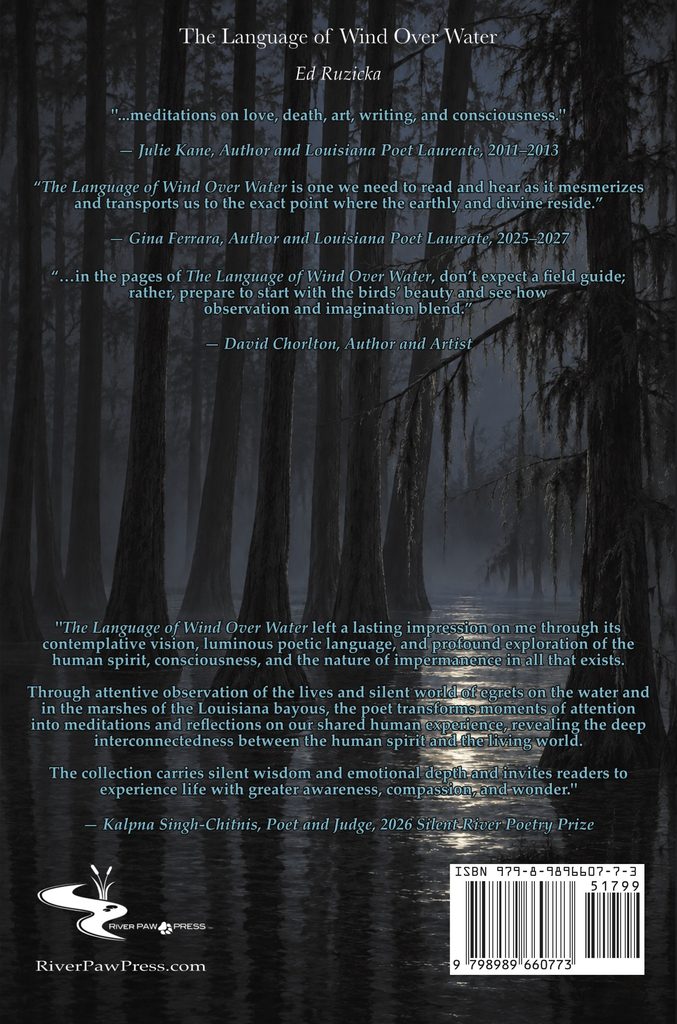
KSC: This collection comes after several full-length books, most recently The Invention of Dreams, released in 2026. Looking across your body of work, where do you see The Language of Wind Over Water in your development as a poet? Has your poetry moved toward different questions, subjects, or ways of seeing over time?
ER: For a long time I just wrote random poems. It was when a friend said, “Cars are America,” that I got my first real theme: the ménage à trois of desire, the American highway and language. I mean, so much of any American’s life takes place in cars. After I first tackled one overarching theme, I became able to translate that to other themes and therefore to write cohesive books.
KSC:What has receiving the 2026 Silent River Poetry Prize for The Language of Wind Over Water meant to you? Has having this particular collection recognized in this way changed how you see the book, or what you hope its life will be now that it is entering the world?
ER: Receiving the award has been amazing. River Paw Press was almost immediately able to create a cover that mirrored the mystery and grace that I hope is in my book. I hope that it was more than luck that I was chosen as the winner.
KSC: You are the president of the Poetry Society of Louisiana. How do you, in your role, strive to support the literary community of Louisiana?
ER: We provide information essential to poets, hold readings, run contests and occasionally print broadsides. This summer we mentored immigrant students in poetry. In October we are teaming up with the Louisiana Organization for Refugees & Immigrants to hold an event that will bring the spotlight on immigrants through poetry and stories.
KSC: What are you writing next?
ER: I have been very prolific these last few years. I have written a book of poems that give backstories to songs from the Great American Songbook such as “Tom Dooley” and “Stagger Lee.” I have been having events for which I read a verse or two of the poem as a guitarist friend plays the song and then he sings a verse from the song. We go back and forth between the two.
KSC: Do you have a final word?
ER: I am also a big fan of William Blake and hope that my poems reflect Blake’s beliefs that one can “see eternity in a grain of sand” and “everything that lives is holy.”
Kalpna Singh-Chitnis is a poet, writer, filmmaker and Editor-in-Chief of Life and Legends
