
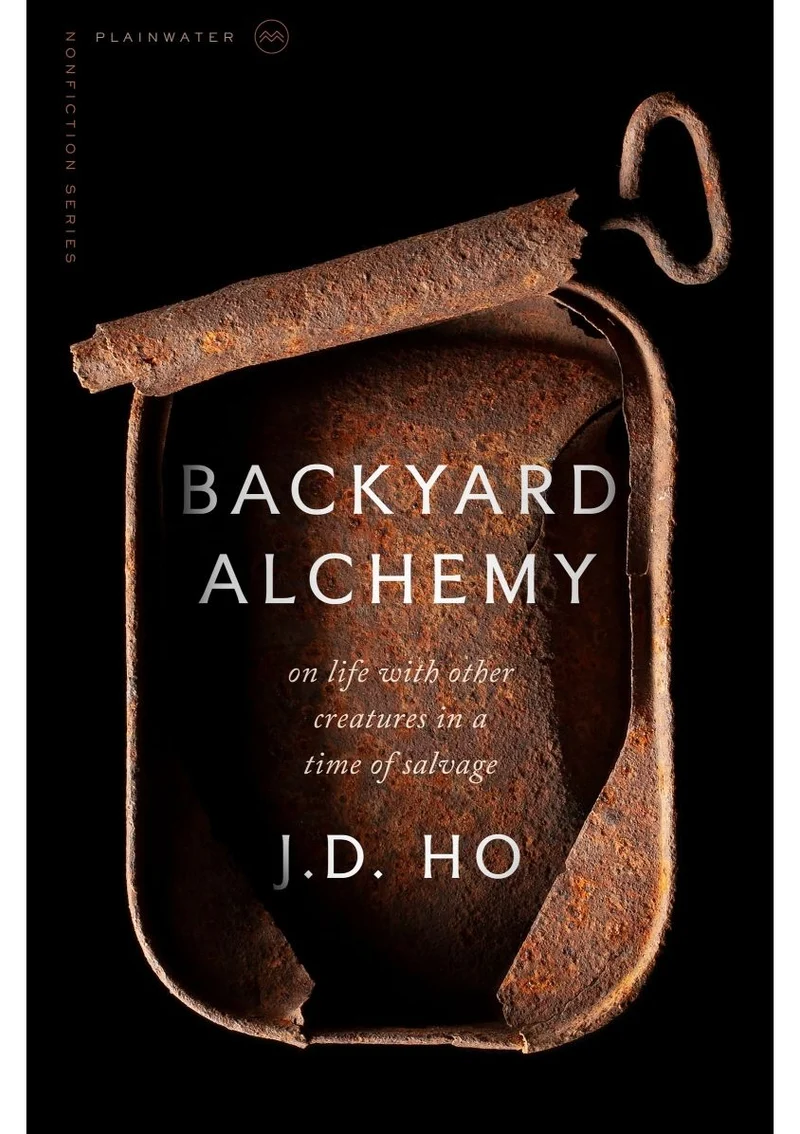
Backyard Alchemy, a book review by Candice Louisa Daquin
J.D. Ho’s memoir-in-essays book ‘Backyard Alchemy’ is a consideration of the natural world in relationship to us. It is a polemic on human greed, waste and destruction. It evidences the consequences, alongside vignettes and histories of places throughout the US, China and Hawaii. However, it is also a treatise to the longevity of ancestors, of inherited learning and legacy. To nimbly pull threads from such a complex tapestry and enthrall the reader with your microcosmic considerations, is no small feat. Ho’s writing being lyric and contemplative, as well as even keeled, whilst probing, feels oftentimes like a tightrope walker, graceful on an impossibly thin wire.
In the past, people could not chart global ecological change in the span of their lives, but we have accelerated the pace of change. I wonder if we will be able to follow the example of the termites, who depend upon one another and the existence of the colony, in order to survive.
Ho’s origin story is intrinsic to their perspectives on the natural world around them. Ho’s ancestors hail from China and they’re fourth generation Hawaiian. Growing up with their grandfather, they learned from an early age to cherish the land, both in their ancestral appreciation for plants, trees and nature and then amongst the adopted land of Hawaii. Ho’s travels have taken them throughout the US, although in Backyard Alchemy they are primarily in the Virginia woods rebuilding an old home off the grid. The ability they have to vividly reflect back to their readership, the aches and landscapes around them, interwoven with ecological messages of destruction and salvation, are deeply moving.
They smell like childhood. They follow me around the garden as I work. They lie in the sun. I don’t spit in their mouths; I already speak their language.
Backyard Alchemy surprised me. With every evidencing of the natural world around them, Ho’s crisp writing drew me into the heart of the woods, to witness alongside them, the death of their beloved cat, the challenges of pulling up roots, to dissolve in poetry-like lyricism, among the trees, to learn of their heritages, the cruelties inflicted upon them and the changeling nature of adopted fauna, insects and trees, who ‘saved’ America when she cut her hard wood trees down and sought fast growing ‘foreign’ trees to make up the deficit. Achingly sorrowful at times, but redemptive in a feeling that Ho is moving past the transgressions of humanity by continuing to build their own wild part of the country, cherishing what remains, Backyard Alchemy is a softer, less clinical voice than Rachael Carson, but has the same gravitas and expansive knowledge about what humanity has done to the natural world.
I think of this place, before the garbage, before the highway, before invasive species galloped over the mountains, flattening everything in their path, before kudzu, ailanthus, bittersweet, knotweed, autumn clematis, privet, autumn olive and stilt grass.
Traveling from Hawaii, through memories of Ho’s Chinese family, into the concreted starving river of Los Angeles and then the ancient floorboards of Ho’s home in Virginia as their partner and they lovingly rebuild the neglected bones of a lost house, we tumble Alice-like, from one story to the next, absorbing the tender ministrations and rougher sorrows of Ho’s life spent mostly in eco-conservation and the writing of it. Whilst an accomplished essayist, Ho’s writing feels their landscape and is not removed from it. It is writing that permits you to inhabit what Ho does, when they climb into the woods in search of treasure, or to unearth the bones of an iron bed from an informal rubbish dump in their backyard that has generational layers of ‘trash.’
It is beside this creek, beneath boulders moved by tectonic collision, that crayfish live. Crayfish, the astaci of Aristotle’s history of animals; crayfish, the foodstuff of tenth-century-Britons; crayfish vital to neurological research, due to their ability to grow back claws, their ability to form neurons from blood cells. Most importantly, crayfish indicate the health of the land around me.
Ho explains that is not off-putting, but educative and fascinating, the sighs and whispers of nature around us, that few observe or recognize. Their knowledge of birds, seasons, histories, transplants, types of trees, histories of planting and removal and historic cycles of growing, are astounding. If I’d been told I’d have responded so positively to a book that primarily discusses wood, metal, debris, rock, soil, water, birds and bones, I might have baulked, but this is an intensely lovely collection of essays, so tender in its ministrations of a world few of us are connected to any more. To say this is an urging exploration, a force of nature, an alternate look at the world around us, only scratches the surface of Ho’s accomplishment.
Maybe it was just my own heart sounding in my ears. Maybe it was the tree’s heart. Maybe they’re the same thing.
If we all considered a little longer, the myriad types of plants, herbs and fauna around us, growing wild between the concrete mass of our cities, to understand their value and histories, the importance of their migrating existence, to glimpse the natural world’s ebb and flow intimately, through someone invested in connecting with that lost world again; I believe we’d view our ecological damages quite differently. We’d connect with the earth in a way that might resolve our anxieties, our disconnectedness and return a wish to protect it. Ho’s writing as an essayist is profound, generational, empathetic and devastatingly true and I felt I had forest bathed after reading Backyard Alchemy.
I watch from my place, tucked in the mountain. These are the sources of my knowledge.
Candice Louisa Daquin is an Egyptian/French author, editor and trauma-therapist. She is Managing Editor at Lit Fox Books, Associate Editor for Life & Legends, Reviews Editor with Austin Poetry Review, and Poetry Editor for Writers Resist. Daquin is author of the award-winning psychological novel ‘The Cruelty.’ www.candicelouisadaquin.com
