
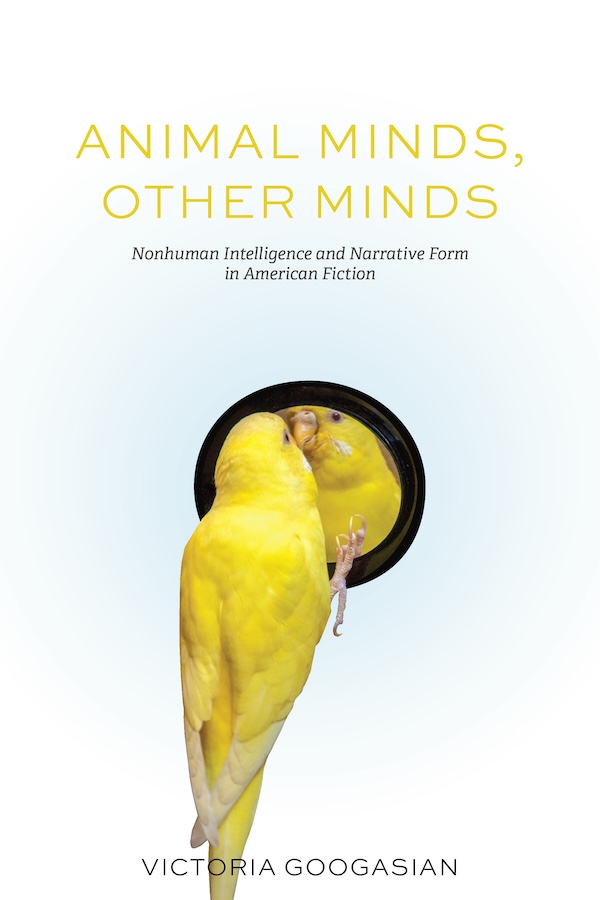
Animal Minds, Other Minds: Nonhuman Intelligence and Narrative Form in American Fiction, a book review by
Thomas E. Simmons
Animal Minds, Other Minds: Nonhuman Intelligence and Narrative Form in American Fiction (University of Virginia Press) nonfiction literary essays by Victoria Googasian.
Once in a great while, a critical literature monograph breaks through the ice of mendacity with its clarity of purpose, focus, and coherence. Such is Googasian’s book.
The interior animal minds most immediately familiar to Western literature lovers might be Jack London’s wolfdog and Richard Adams’s rabbits. Obviously, animals-as-characters are decidedly more ancient. Yet fables and folktales involving talking animals presume, rather than explore, animal perception, perspectives, and consciousness. The more contemporary tale concerns itself with what it might be like to enter an animal’s thoughts; what it would feel like to be an animal. (Or an android; or an alien.) Such contemporary stories of non-human minds are a fertile subject.
Yet Animal Minds, Other Minds: Nonhuman Intelligence and Narrative Form in American Fiction barely pauses at this vista before plunging into the intersections of narration and animal minds. Victoria Googasian asserts that literary demonstrations of cognitive diversity are less political than narrative, especially within the context of the American realist project and its emphasis on characters.
Greater concern with narrative representation of non-human minds, she claims, does more than delineate the edges of human consciousness. It introduces a “multispecies narrative poetics.” It presents a different, wider view of the universe.
Along with plumbing narrative theory, Googasian weaves in early 20th century politics and the Nature Faker debate as well as scientific advances. If literary animal consciousness has failed to resolve political contests and outpaces science, then this reflects literature’s role in the human experience quite aptly.
Consider, she teases, a passage from a particular political bit of literature, Upton Sinclair’s The Jungle wherein upon entering the slaughterhouse, pigs’ interior lives are questioned. While these “embedded pig narratives” might be read as “biopolitical allegories,” Googasian sees Sinclair’s novel differently:
“The Jungle tries to make light of the new, post-anthropocentric distribution of sentience – the “hot squeal of the universe” about which the novel jokes – but by its conclusion we are left with a deadly serious vision of finite human characters dwarfed by a vast cosmos squealing with minded intention.”
Googasian’s connected essays span a nuanced introduction, four chapters, and an evocative coda. While her examinations of modernists like Faulkner, Stein, Steinbeck, and Hurston are excellent, it is her final chapter which is the most revealing. There, she contrasts the “imaginative engagement” of Philip K. Dick (and his androids) with Octavia Butler (and her condors).
Both authors used post-apocalyptic mass species extinction settings. Both gesture to extinction- level threats and an ecology of scarcity. Both situate power inequities as a means to extract the ethics of the other-minded among us; an interspecies-relations ethics.
At the same time, such a “multispecies pansychism” retheorizes the role of the literary character altogether. The interiority of non-human minds can upend what a character represents (like Sinclair’s pigs) but also what a character is. Moving beyond the non-human mind as a marginalized opaque cypher, Butler and Dick tease out an ethics of consciousness, an ethics which ignites a new Nature Faker politics. They ask not so much what non-human consciousness tells us about human consciousness, but what it tells us about non-humans.
With Dick, an ambivalence remains. While he delighted in the life-like possibilities of cybernetics, the electric animals in Do Androids Dream of Electric Sheep? are status symbols foremost and secondarily, imitations – fakes (a recurring motif in his fiction), an undermining of the very fabric of reality. For if we lose what is authentic on account of a surfeit of increasingly convincing replicas, what are we left with? The bottom drops out. (Dick also feared the mechanistic worldview that cybernetics favored.)
For Googasian, this discourse heralds the extinction of not just endangered species but of autonomy in American literature’s conception of characters. “In place of a narrative ethics of personhood, these works substitute the ethics of biocentrism,” she writes. Speciesism thus potentially partakes of the worst aspects of both tribalism and globalism, for if the preservation of species supersedes the survival of individuals, an unstable world results. Many readers (rightfully) envision such a future with anxiety, an anxiety which permeates Dick’s fiction and accentuates Butler’s.
Googasian’s multidisciplinary dissections of character and narrative succeed in what a good literary critic does best. She enhances the literature under examination; enriches it by expanding the reader’s mind in the same way that a multispecies mindfulness narrative can. Her is an enlightening and energetic critique of the highest order. Readers love a book like this one; it presents literature through a different lens; it helps literature lovers become better readers.
Thomas E. Simmons is the author of Soviets on Venus, among other works. He is also a probate lawyer, a part-tribal appellate justice, and the McDowell, King, and South Dakota Trust Company Chair in Trust and Estate Law at the Knudson School of Law in Vermillion, South Dakota.
