
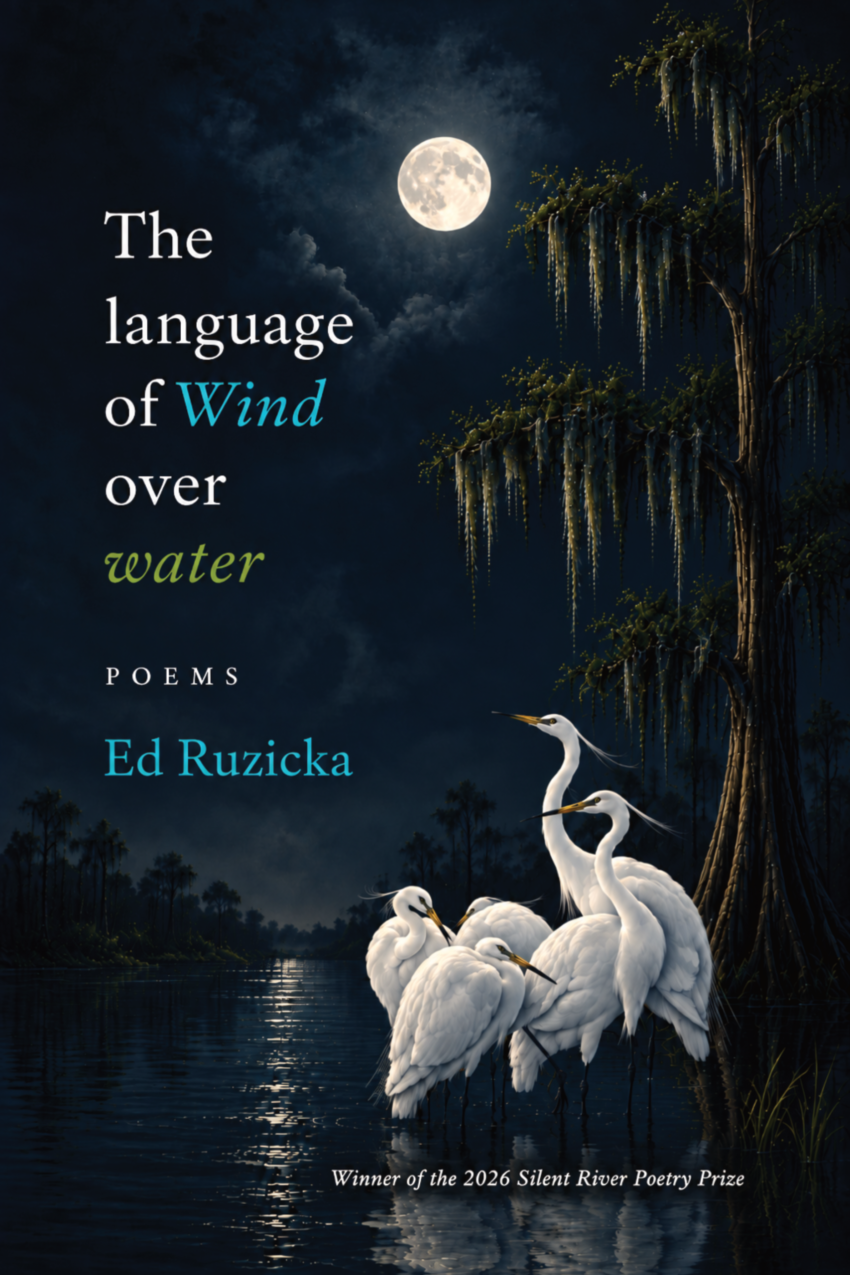
The Language of Wind Over Water, a critical essay by Candice Louisa Daquin
The Language of Wind Over Water (River Paw Press) a poetry collection by Ed Ruzicka
Winner of the 2026 Silent River Poetry Prize, Ed Ruzicka’s The Language of Wind Over Water is
a contemplative collection in which stillness and movement, silence and reflection are deeply
intertwined. The poems move through the natural world with Zen-like attentiveness that often
opens into larger questions of consciousness, perception, and human experience. In “The Egret in
History,” Ruzicka writes:
because the tongue
is too thick
for elegance.
This poem feels like an acknowledgment of the limits of language and the necessity of devices
within language to represent greater things than language. In reference to balance between wind
and will, Ruzicka reflects on the idea of a man in Mississippi being influenced by the flight of
egrets, while acknowledging that describing these things is almost impossible. It appears almost
contradictory to imagine writing of the egret when we consider this paradox. Yet reconciliation
becomes the balance we seek. While reflection is a form of “looking glass,” the poem
complicates that idea in “Egret in Facets”:
But no. The egret
is a window
onto the other side
of night.
Reflection and looking glass are very static, human-borne definitions, whilst this collection is
liquid, moving, transforming. Ruzicka’s poetry often acts as a lighthouse or conductor: rather
than merely seeking to define a feeling, it asks the reader to inhabit one. This aligns with one of
his observations:
“One has to lose their voice to find the voice of the poem. Then the poem can return within the
poet’s voice.”
A related image appears in Dōgen’s waka “Raihai,” in which a white heron disappears against a
snowy field. In Shōhaku Okumura’s translation and commentary published by the Dōgen
Institute, the image becomes a meditation on oneness and distinction; Okumura also relates it to
zazen as a letting go of grasping at the self as a fixed entity. The egret’s stark white plumage is
echoed in Ruzicka’s writing, where it can become “nothing” and yet, symbolically, “something.”
This could also relate to selfhood within a poem, where the poet’s “voice” is lost alongside ego
and self, expanding into a universal message. At times this is deeply sensual, as in “Alcoves”:
Woman, alcove, egret
all hold in their core
a place that seems
deep enough to have begun
This sensual world is held within a greater landscape as a compatible contemplation. In terms of
the self in Ruzicka’s poems, he has said of his writing: “Some poems call for a fierce sense of
self while others rise up as if written by an unseen hand.” The poems suggest that loosening the
boundaries of self may deepen our sense of interconnectedness with the environment. In “Then
Owls Start Up,” Ruzicka speaks of nature and then turns that consideration toward human
experience, where coexistence enables a different kind of understanding:
Erasures, like when after sex one falls to null
or when you go down with the count under anesthesia
and a wavelength from the hereafter, from the herebefore—
both equal, neither distinct from the other—seeps in.
Ruzicka’s commitment to poetry also extends into literary community through his service as
president of the Poetry Society of Louisiana. As a retired occupational therapist, physicality feels
like an essential element in his poetry alongside the natural world. With five full-length books to
his credit, his poetry has appeared in highly respected publications including Atlanta Review,
Chicago Literati, and Rattle. He has also received three Pushcart Prize nominations and has been
a finalist for the Dana Award and New Millennium Award.
flap wings wide
to separate themselves
from their reflections
in shallows that dusk
has turned into a teeming
champagne-pink.
(“Subterranean Birds”)
In “Between Shafts of Light,” there is a different kind of inhabitation, extending the collection’s
attention to living in relation to the egret. Ruzicka’s poetry is the opposite of static, and this
quality blends almost imperturbably with the natural world. His language feels as though it
continually moves. In his short poem “Turn, Turn, Turn,” even the title is in motion:
with night’s black ink
the egret spread its wings.
Its only cry,
a blank expanse.
Pearled silence
of the page.
Another recurring theme, alongside the natural world, is the relationship between humans.
Ruzicka was born in rural Illinois and has a large family, and nature and love emerge as recurring
tethers within the poems. In “Emanations,” he writes:
In the heart
of the swamp
an egret
is the absence of color.
In discussing symbolism, this renders in the reader’s mind an egret both part of and apart from
the landscape. Most specifically, the “absence” of color possesses significance while
approaching a kind of “not being.” By symbolically disappearing into the world, the egret can be
read as suggesting a loosening of the ego’s boundaries rather than an assertion of separateness.
This can be read alongside the Buddhist teaching of anattā, or not-self, which questions the idea
of a fixed, permanent, independent self.
Each bird settles,
grows still, as if
separate from other egrets
although it is not.
(“They Are Not”)
If existence occurs through causes and conditions rather than permanently in isolation, the
exterior natural world and interior experience begin to blur. Can we then ever truly divorce
ourselves from what surrounds us? Modern living often attempts such a separation, while poetry
can resist that disconnection. Read through a contemplative lens, Ruzicka’s vivid language
becomes a form of sustained attention to raw nature and its spiritual possibilities:
When Basho
read the tracks
of an egret in mud
he realized
there is no way
into eternity
without wings.
(“The Egret in History”)
American Southern writers and poets often draw upon cadence and the rhythmic natural world in
ways that evoke physical landscape. Ruzicka paints vivid imagery of the American South
throughout The Language of Wind Over Water, to the extent that readers can feel the bayou,
Spanish moss, magnolia trees, and cicada song cutting through stillness alongside him. This
anchors his work by rendering landscape as a reflection of identity and then, at times, dispelling
the need for identity. In his redolent poem “Out Late in the Atchafalaya Basin,” he seems to hint
at such loss becoming more than humanity’s obsession with gain:
silence
swallows
what words
I had
Whilst oral traditions exist across cultures, the American South has a rich storytelling history in
which poetry, song, and spoken cadence often intersect. It is difficult to imagine transplanting
Ruzicka’s words to another region; his writing is deeply situated in the vernacular, oral tradition,
and natural beauty specific to Louisiana. Even in “Trane,” about saxophonist John Coltrane, his
language harkens back to rhythm, like a deliberate river returning to its source:
See an egret stand, untouched
as a coal that burns, that burns,
even as clear water bathes it.
In relation to Buddhist thought, the egret within Ruzicka’s poetry can be read as a figure of
mindfulness and awakening, partly because the bird’s stillness and alertness lend themselves to
contemplative interpretation. This resonant form of questioning and emptying of selfhood
becomes part of the collection’s language, often returning, as if in flight, to the egret as an ever-
expanding symbol:
wind-ruffled, yet thin
as an exclamation point
(“Aubade for Estate Sales and a Fifth Green”)
The natural world, however, is not the only consideration within this collection. While the book
may initially appear to be centered primarily on birds, a closer reading reveals how Ruzicka’s
recurring egrets open into considerations of consciousness, impermanence, and human
experience. A related image appears in the “Song of the Jewel Mirror Samadhi,” attributed to
ninth-century Chinese Chan master Dongshan Liangjie. In the translation used by the San
Francisco Zen Center:
Filling a silver bowl with snow,
hiding a heron in the moonlight.
In The Language of Wind Over Water, similar contrasts appear through the egret:
I have said of the egret’s language
only silence and the white
feathers of silence.
(“Onyx”)
A connected sense of opposition furthering insight is reflected in this poem. It is not necessary
for such inquiry to be evoked through a bird, but within this collection the egret proves an ideal
presence. The poems also leave room for readers to arrive at different meanings as the images
evolve and transform across the book. In “To Name a Few,” there is a less metaphorical, more
literal presentation of how the natural world works in relation to us and our sense of community
—a juxtaposition of home and humanity’s physical urges alongside nature:
There is the river’s sculpting of land
and how rock channels the movement of water.
There are chairs and beds and hearths in homes
along with all the unique kitchen implements.
There is the power sex holds over us
every muscle, every act.
The Language of Wind Over Water possesses powerful symbolic possibilities in Ruzicka’s choice
of egret and other fowl. Egrets are also remarkable for their physical patience, standing still for
long periods before striking with precision. As a reader, the visual connection betweenmindfulness and the egret is difficult to miss, especially as we inhabit language that paints the
birds so vividly. In “An Aspiration,” he writes:
An egret
is never a star
never a fixed point.
This concept may be read alongside Zen ideas of releasing rigid thinking and allowing the mind
not to remain fixed on a single point. The egret can act as a mirror for minds that become
confined by fixation, suggesting the possibility of a larger identity beyond individual need. There
is also a specific historical basis for associating the great white heron or American egret with
peace in Cherokee tradition. In Myths of the Cherokee, ethnographer James Mooney records that
feathers of the tskwâyĭ, identified as the great white heron or American egret, were worn by ball
players, and he suggests that this may have been the bird whose white wing served as a peace
emblem in ancient times. Rather than representing Native American traditions as a whole, this
specific Cherokee reference offers another cultural context in which the white bird carries
symbolic resonance.
Balance recurs throughout The Language of Wind Over Water. Through repeated attention to
wind, water, light, and the atmosphere of the bayou, Ruzicka enables readers to inhabit the
landscape almost physically. At times the sensory imagery draws us in so palpably that it is
difficult not to feel present within it. There is a tradition in Louisiana writing of this level of
panorama, including in the fiction of James Lee Burke, that can be languid and intensely sensory.
Here Ruzicka writes of the egret:
you will not capture how
that eye is also trained backward
beyond even Paleolithic eons.
(“One Thousand”)
What remains after reading The Language of Wind Over Water is how Ed Ruzicka’s poetry
employs a layered rhythm, where the temperature and length of words can feel like a spoken
voice on the page. Readers can also feel the poems considering how valuable it is to quiet the
mind’s urge to categorize and define reality, allowing the natural world to loosen attachment to
fixed labels:
Razors of moonlight sharpen the night.
The egret fans and preens pearled light.
(“Delight”)
There is a historical rush through this language, sweeping rather than confining, carrying all that
has been and all that is yet to come. The natural world allows these observations to open toward
larger questions. Likewise, the movement and stillness of the egret can resonate with Buddhist
and Zen ideas of non-attachment and action without clinging to a fixed self. This can conjure the
idea that we are part of a continuous flow within nature and that strict separation from the larger
world may itself be an illusion.
The egret also enters an intimate register in “Why to Marry an Egret,” where Ruzicka writes:
I heard her
parting water.
Not moving.
Parting water
The vulnerability of this watercolor-like image does not feel like “self” so much as an
acknowledgment of interconnectedness and the universality of love.
This is a compelling manuscript that holds its readers through the accumulation of image,
reflection, silence, and movement, continually returning us to questions of perception,
relationship, and what matters most. We end with lines from “Thursday Morning, Redman
Lake,” and congratulate Ed Ruzicka on the recognition of The Language of Wind Over Water
with the 2026 Silent River Poetry Prize:
What timeless silence
wells inside of water.
Star-clear wings
glide reflected
Candice Louisa Daquin is a psychotherapist and editor. She currently works for Lit Fox Books (Austin TX), Life & Legends, Writers Resist and Austin Poetry Review. Candice’s debut novel ‘The Cruelty’, is an award-winning expose of cruelty and survivorship. www.candicelouisadaquin.com
