
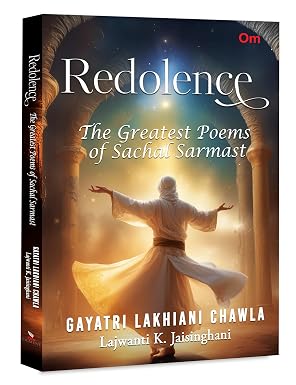
Redolence: The Greatest Poems of Sachal Sarmast, a book review by Candice Louisa Daquin
From a culture permeated by Sufi ethos, there has been a reclaiming of the heritage of Sindhi literature, which after India’s partition and the subsequent cultural uprooting had become marginalized, with many growing up oblivious of their cultural history and roots:
Sachu says; you arrive here,and become one with me,
and erase caste and creed.
Whilst the poetry of Sachal Sarmast was not read but heard; through this valuable co-translation, his mystic work is now shared with an English-speaking readership.
Saint Sachal says, if you are a true dervish,
then you will understand;
for others, there is nothing in it.
One of three ancient scripts; Sindhi is Persio Arabic, (distinct from the more common Devnagari and Roman). The idea of a language being unknown to those whose ancestors spoke it, begged for a robust literary exchange:
Sachu says, truth is born within me
why should I sing the worldly tales of lies?
Sachal used Doha’s, Kafis, Ghazals and Masnavis poetic devices, through ecstatic meditation that juxtaposed folk stories alongside allegories of the separation of lovers, as a reflection of his own inner state of being; that of the literal but not spiritual absence of the Divine. The Kafi being a classical form of Sufi poetry, where such poems were sung in high and low pitches, became Sachal’s voice:
I am something;
this is a cage
first, erase this cord.
Gayatri Lakhiani Chawla, an award-winning poet, translator, and French teacher from Mumbai, India, has focused her translations of traditional Sindhi Sufi poetry into English, concentrating particularly on the spiritual verses of saint and poet Sachal Sarmast:
You neither recognise nor know me;
still, I am greedy to meet you,
The project of collecting the ‘greatest’ poems of Sachal, became a five-year labor of love with co-translator, Lajwanti K. Jaisinghani, referring to their source text, Lachman Hardwani’s book Sachal Sarmast ji Kavita as an invaluable guide:
Where were you not born,
and from where did you not come?
Chawla said of the English co-translation; “each poem was first read aloud, with my translator Lajja deciphering the Sindhi words in English sometimes Hindi. Then I would write a rough draft working towards a final draft in English.” This, to energize the unraveling of multi-linguistic transliteration:
Sachal called himself Sachal
and hid amongst the world of people.
It wasn’t straightforward partly due to Sachal’s poetry not being easy to translate; “his poetry is layered, but as he is a mystical poet it is essential to leave something behind for the reader to reflect and explore, to understand his poetry in tonality.” This complicated relaying form of two simultaneous translations required returning to source to ensure no loss of reflection occurred:
How bubbles float in water,
like a body with life within
ego will bid farewell to you,
as if you were never born.
Chawla was aware that: “The connection that (Sachal) has with the divine is riveting in that he amplified the fact there is no disparity between the religions and the only truth or reality is the divine.” It was this pure essence; she hoped to retain:
I became prosperous
in the unawareness of self,
Sachal Sarmast (1739-1827) was born Abdul Wahab Farouqi, in Sindh. With a history of spiritualism, (his grandfather being a dervish) Farouqui became known as the ‘truthful mystic,’ explaining his spiritual name Sachu, which means ‘truthful,’ whilst Sarmast translates to ‘ecstatic’ in Sindhi and Urdu.
For whom you are fighting
is fighting within you.
Sachal devotedly followed Wahdat-ul-Wujood, a Sufi philosophical doctrine translated to ‘Unity of Existence; or ‘Oneness of Being,’ believing the only true existence is God and our universe is a reflection of His reality: “What is inside is outside / who will sacrifice themselves for this truth?” Known as the Poet of Seven Languages, Sachu wrote poetry in Hindi, Sindhi, Saraiki, Persian, Punjabi, Farsi, and Urdu, making it auspicious this polyglot has been translated into another language.
Sachu says, sacrifice your head
only for a path
that is trustworthy.
As Chawla says, as Sachal’s poetry was not read but heard, “it was his audible presence which captivated me all along.” This led to crafting their co-translation into a relatable English without losing the poems’ roots: “Sachu says this bargain is one of truth, / not deceptive like glass bangles—broken.” In their transcreation work, they researched with visual and auditory aids, to comprehend more deeply, the complexity and esoteric meanings of the Sufi texts. Literally, a voyage of words:
They made a house abroad,
not once spending a moment of time.
Chawla concluded that the art of translation leaves translator as a medium of sorts; “a narrator between writer and reader.” One could expand upon this in relation to Sachal and say this translation can also be experienced at a transcendental level:
Sachu says, why you seek refuge elsewhere?
In another place, you will be
but a guest.
To a Western audience, the cultural nuances and folk stories are unfamiliar, but essence becomes the signpost to inhabiting the deeper messages:
he says, what exists, exists;
what else will one make of it?
Sachal’s universal messages remain highly relevant and timely; His poetry continues to carry the message of love, unity and peace, which is why Chawla sought to share his voice with modern new audiences:
Neither am I a mullah nor a qazi,
nor do I teach lessons to anyone.
(I am what I am, neither Hindu nor Muslim)
Candice Louisa Daquin is a psychotherapist and editor. She currently works for Lit Fox Books (Austin TX), Life & Legends, Writers Resist and Austin Poetry Review. Candice’s debut novel ‘The Cruelty’, is an award-winning expose of cruelty and survivorship. www.candicelouisadaquin.com
