
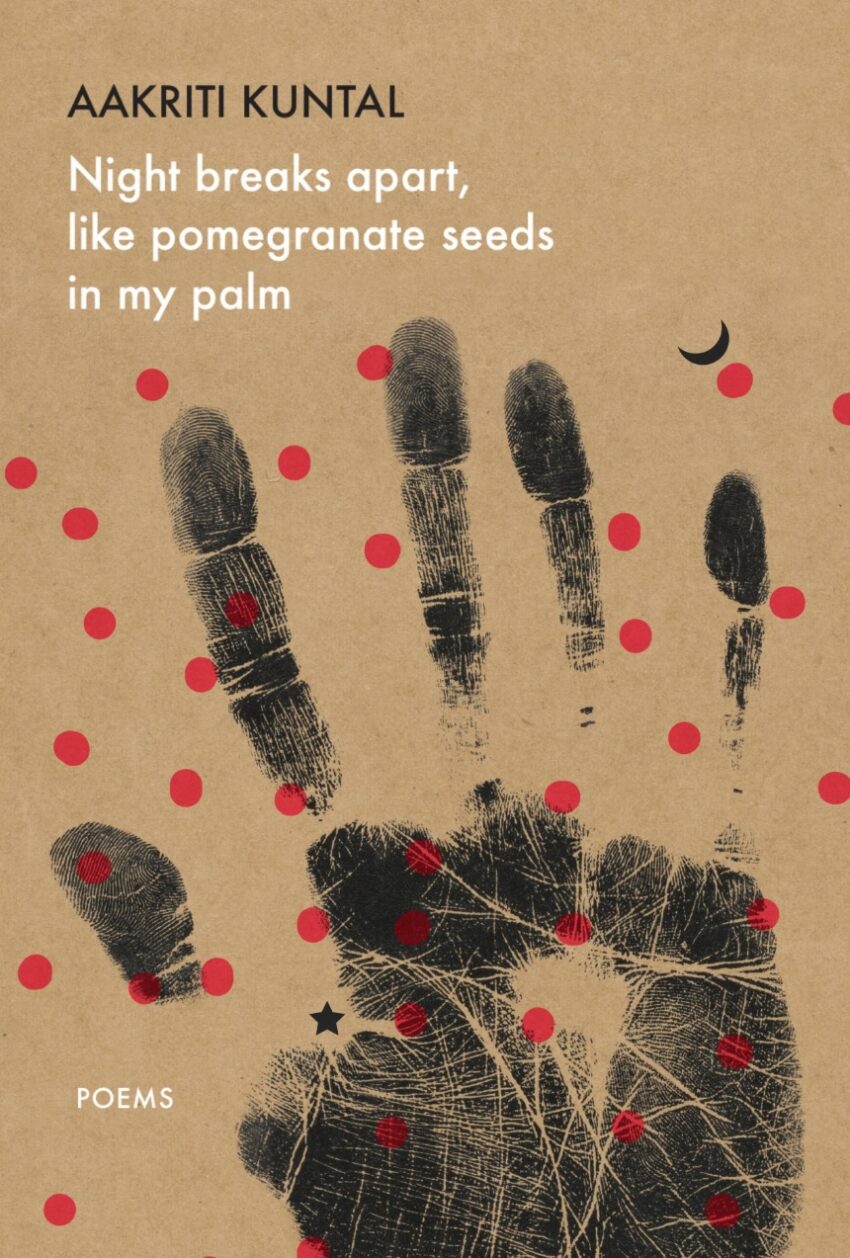
Night Breaks Apart, Like Pomegranate Seeds in My Palm, a book review by Candice Louisa Daquin
Profound and female-driven, in terms of content and depth, it’s exciting to find this debut collection of Aakriti Kuntal’s poetry contains vividly descriptive poems like ‘NEELMOHAR IN A SULPHUR SKY’ :
your sharp movements in space dulled by the thread of the eye
waves, lines, lines—stacked into an oceanthe body collapsed into a fever—
Light like a rod across all being
With some surrealism there’s no clear meaning. Kuntal’s work possesses both. The sheer intoxication of her language alongside this surrealist structure, mesmerizes, it’s more than beautiful, it stirs something within. Poetry can be so self-conscious. She appears to write almost in a trance at times. In her poem ‘Frame’ she writes:
I slide my fingers
through the vertebrae of fixated air
conceive a frame and fall through
I thought immediately of her physical struggles with health, which seemed ratified by the subsequent lines:
They hang, my paper boat thighs
they hang in mid-air paralysis
Reminiscent of Frida Kahlo’s art, in that she painted her infirmity as much as her interior and exterior soul and life. Perhaps Kuntal writes using surrealism to avoid poetry describing physical illness in a staid, literal way? In her poem ‘Murky’ she asks one of her incredible questions within the poem:
God, did you pinch my very tongue and scream?
Are you standing, all lather,
in grandma’s petticoat?
Are you the rain?
The marble floor?
My balcony is a ball of black seeds.
It is this combination of acute visuality alongside the creative interpretation of that visuality and what she chooses to focus on or introduce (balconies becoming balls of black seeds) that really transports the reader into her interior world (questioning God, asking if they are past-present-future, neither, all). One of her greatest abilities as a writer is how she can coax all that in a single poem. In ‘ORIGAMI DREAM’ she talks of dreaming and in that dream:
I’m made of paper. A paper folding and
unfolding, folding, unfolding. There is a scissor in my mouth
and a cavity in my large stomach. I am a dream, a dream of
paper. I’m almost done. I do not exist. I’m so thin I could
compel myself into non-existence.
I found it deeply moving to consider her consideration of the physical self, alongside the spirit self, and perhaps, the dreaming self. When she writes, she beholds multiple directions and personas, as if she’s able to break a kaleidoscope down into its various parts. One of the most shockingly honest poems ‘DEBT’ in her collection says:
What is it that flows between two hands but never dies? / What
is this? / This unspeakable word on the cliff of my throat/ this/
this which has been felt before/ I’ve known it/ this glorious
madness of no end/ of only living/ this sickness of love that
bursts through the two vertical halves of the body/
I wondered what does madness or altered states of being play into surrealist writing or as a muse? For example, in the poem ARTERY she writes:
In madness, reigns the eccentric song of the heart. The dreadful
rose heart, almost terrified, almost smitten with its own severe
palpitation. Its unquenchable need to be, its admirable desire to
not.
Which could be a reference to (slit wrists/impulse to die) or more about literal physical ailments or a figurative allegory to existence, ego and longing. She is unafraid to focus on challenging subjects. For many, this is avoided, to make their poetry more mainstream or palatable. It’s an interesting liminal space she’s carved out, seemingly a genre of her own. In the poem ‘On Nightmares’ she writes:
The juice is everywhere, but who can see things when
they spill?
There’s only the smell and the incense of the heart
vomiting into the night. The night has been cut short,
the dream severed.
Literal interpretation isn’t always necessary, she may seek her readers to ‘feel’ what she writes more than get mired in the literalism, where it’s less important if their interpretation is ‘correct.’ In the same poem she states:
I am both dead and alive. I wake having swallowed my
own death.
In the dream, I am man, woman, animal and light, all
with a jarring sense of night. The night a mad rider
with red hair.
In this dream, the mind eats the body and spits it to
make the day.
In this dream, I am the vivid strain of fear. I am bright
red and dimming
black.
The poem is jaw-dropping in its visual representation(s) but also there’s such a story-within-a-story and a series of considerations layered atop of the next. You can’t read Aakriti Kuntal’s work in one sitting, it asks for deeper contemplation. In ‘THE-FIRST-FACE-IS-A-VALENTINE–RED’ she opens with the lines: “What is the reckoning for a stolen life?” Which immediately struck me as a battle cry. She then goes on to further this theme with:
The wrist cuts through the atmosphere—
twice in each circle,
reliving its own inexplicable birth
I ‘saw’ this as a dance of sorts, a parody, paradox, ironic take on wanting to die, wanting to live, all with the imagery and metaphors of movement. As a respected poet and multidisciplinary artist whose creative pursuits span literature, visual arts, and experimental film, this first collection is an outstanding debut for its contribution to the surrealist poetry genre and beyond.
Candice Louisa Daquin is a psychotherapist and editor. She currently works for Lit Fox Books (Austin TX), Life & Legends, Writers Resist and Austin Poetry Review. Candice’s debut novel ‘The Cruelty’, is an award-winning expose of cruelty and survivorship. www.candicelouisadaquin.com
