
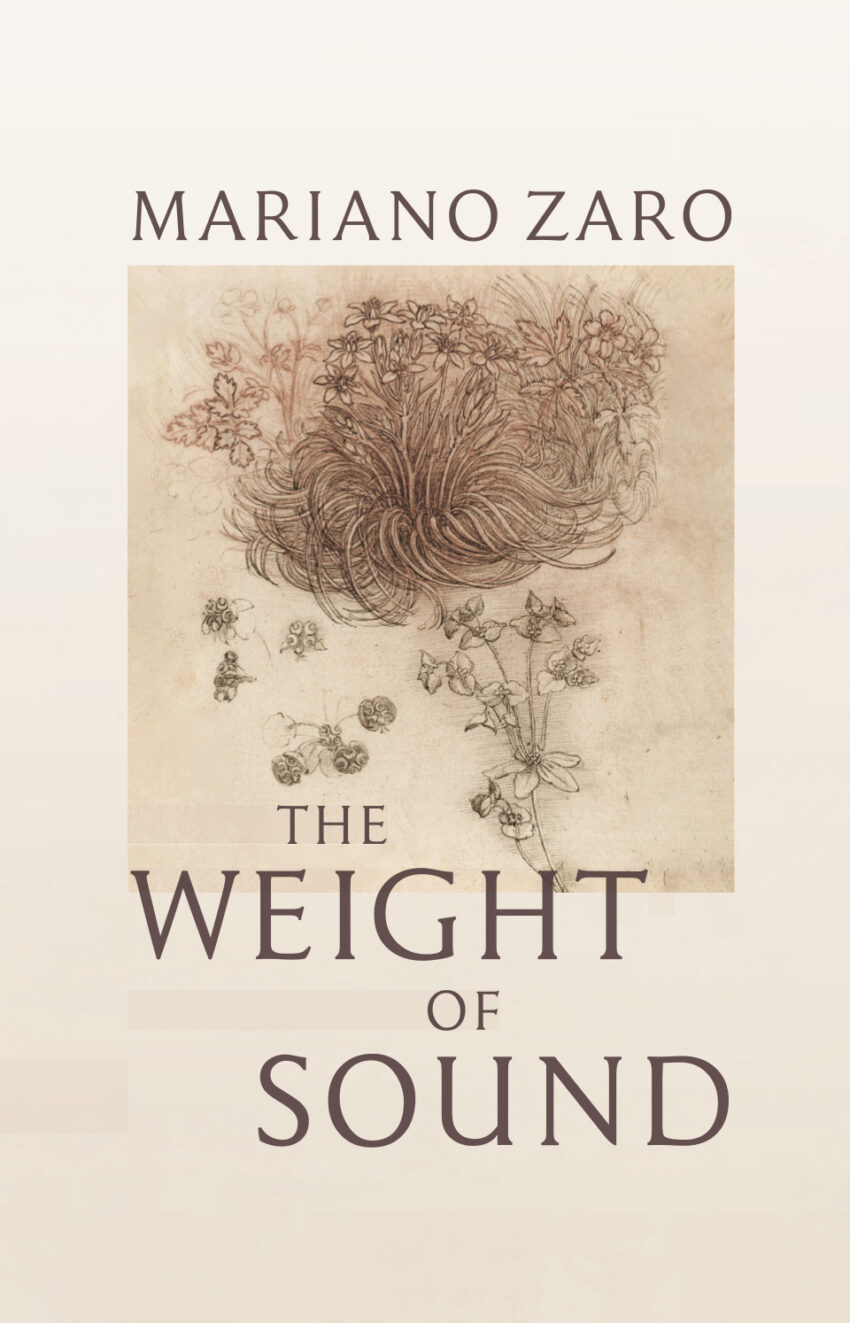
The Unbearable Patience of Desire: On Mariano Zaro’s The Weight of Sound
A book review by José Enrique Medina
The Weight of Sound (Walton Well Press) a poetry collection by Mariano Zaro
The Weight of Sound by Mariano Zaro does something most poetry collections only pretend to
do: it holds still. And in that stillness, the speakers cannot escape longing, grief, or the body’s
slow betrayal. These feelings simply accumulate. Because every poem unfolds in the present
tense, the book creates the feeling of a body unable to leave the present moment—illness,
wanting, and deterioration happening simultaneously, as though memory itself has been refused.
What makes this remarkable is Zaro’s restraint. He rarely dramatizes pain. Sorrow arrives
matter-of-factly, almost without announcement, as if suffering is not interruption but condition.
Even intimacy feels shadowed by entropy. These poems carry the sensation that everything
contains potential sorrow stored inside the body like pressure.
This restraint finds its purest form in “Mandarin at the Edge of a White Formica Table.” A
student visits his French professor’s apartment after class. Almost nothing happens outwardly.
And yet the poem becomes one of the most charged explorations of desire, postponement, and
emotional suspension I’ve encountered in recent poetry.
The entire poem operates through small acts of self-concealment. “He serves green tea in
terracotta cups. / I don’t like green tea, but I pretend.” The lie is almost painfully minor, which is
precisely why it matters. The speaker cannot even confess a preference, much less desire.
Longing here never travels directly.
It moves through objects, rituals, indirection. Even alone in the bathroom, the speaker cannot
bring himself to touch the professor’s bottle of vetiver cologne, afraid of crossing a threshold
even when no one is watching, even when the object itself is not the beloved. The professor’s
dry, parched lips. The marks of his upper front teeth on his lower lip, memorized like an
engraving. The small oval stains of tomato sauce on the Belle de Jour poster: erosion, damage,
the body’s quiet argument with time.
Even the poem’s structure performs postponement. The repeated lists of French filmmakers—
François Truffaut, Jean-Luc Godard, Claude Chabrol, René Clair—interrupt the emotional
current the way both men interrupt themselves, choosing cinema over confession. The names
become a language the two men can safely inhabit together, discussing directors and movements
with complete fluency while remaining almost entirely silent about the desire that has brought
the speaker back week after week. Conversation itself becomes another form of restraint.
Many other poems in the collection employ a similar formal strategy, using indented passages to
create the impression of two parallel consciousnesses unfolding at once. One occupies the visible
world of conversation and ordinary activity; the other carries the emotional life that cannot be
spoken aloud. Whether confronting desire, illness, family, grief, or mortality, Zaro repeatedly
separates what happens on the surface from what the speaker is actually thinking. The result is
not merely a visual innovation but a formal embodiment of restraint. The weight of the collection
lies not only in what its speakers feel, but in what remains too frightening, too intimate, or too
heartbreaking to say.
For one of the only times in the poem, attraction appears mutual. “His fingers expand over the
fruit bowl. / He takes eight mandarins, four in each hand.” The speaker imagines the professor’s
gesture enlarging beyond proportion, as though restrained feeling has momentarily exceeded the
body containing it. The excess is precisely what gives the moment its emotional charge.
When touch finally arrives, it passes through fruit. The professor presses mandarins against the
speaker’s chest; the mandarins touch where he cannot. And when the speaker says, “I wouldn’t
know what to do with all these,” the line carries far more than citrus. Fulfilled love feels almost
unimaginable: too much, too exposed, too real.
This idea of desire as something almost too large to survive extends across the collection. Zaro’s
speakers consistently stop just short of naming what they need, and that restraint is not timidity.
It is the formal argument of the book: that what we cannot say shapes us more permanently than
what we can.
By the end of “Mandarin,” the fruit rolling toward the edge of the white Formica table becomes
the collection’s central image. Both men want it to fall. It doesn’t. The Weight of Sound lives
entirely in that suspension—the approach, the refusal, the unbearable patience of desire that
knows better than to arrive.
José Enrique Medina is a poet, playwright, and novelist. His poetry collection Haunt Me won the 2025 Rattle Chapbook Prize, and his verse novel Only the Dead Let Me Talk This Much won the 2026 Lambda Literary J. Michael Samuel Prize. He was selected for the 2026 PEN America Emerging Voices Fellowship. His work has appeared in USA Today Hispanic Living, Los Angeles Review, Best Microfiction 2019, and elsewhere. Connect with him on IG @MedinaWrites.
