
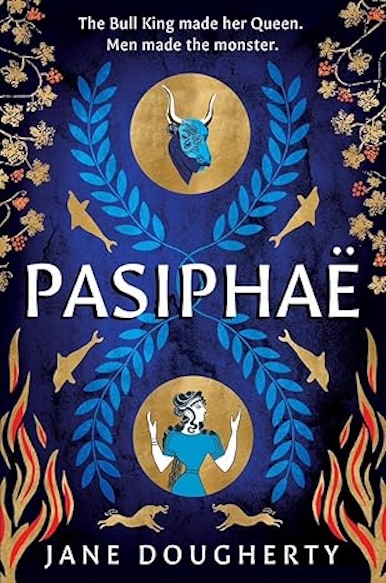
Pasiphaë: A book review by Candice Louisa Daquin
Pasiphaë (The Book Social) a novel by Jane Dougherty
Myth retelling can go horribly wrong if handled improperly and become something of a marvel if the writer has a good historical background and unique slant on the myth, though it is always risky to reimagine something without extensive research. The ancient Greek world is vibrantly and provocatively reborn in Jane Dougherty’s sweeping novel Pasiphaë. Daughter of sun god, Helios, Kolchis Princess, Circe’s sister, young fifteen-year-old Pasiphaë as key character in the eponymous book, possesses the fantastical elements that make mythology such appealing source-material, without losing the historical veracity and thus, ultimate credibility. It is at once, a female-lens version of the reign of Queens and Priestesses in ancient times, yet, as we think we know the ‘monster’ at the center of this myth, we are surprised by what is revealed and the consequences of our main protagonists’ decisions.
Pasiphaë’s specific story-arc is briefly known; she married Minos, becoming Queen of ancient Crete. But once beyond this two-dimensional outline, Dougherty shapes her into a fully realized woman, caught between intrigue and the need to protect her own. It’s a literary tight-rope to achieve this and she’s succeeded with Pasiphaë, not only because of her own background in ancient history, but a clear love of her subject-matter, making this less about traditional gods and monsters, and more of a feminist updating of the much-neglected Pasiphaë story.
When I say feminist, that’s generalizing, because the writer doesn’t embark on re-writing a male canon, so much as delving into the Pasiphaë story to the point of reclaiming her without succumbing to archaic cliches and it is this, which is strictly feminist, though a good story is without doubt, the basis of this creation, more than a social polemic. The other element that is woman-based is the idea of women ruling (until a man deems that should change) which is exactly what occurred many times throughout ancient history (and one could argue, still does). As a fan of realistic histories, I connected with this fierce well-crafted adaptation of the Pasiphaë myth far more than if it were more of a monsters/gods version, because Dougherty has done her research and where else in modern literature will you encounter and have to refresh yourself about Minoan deities, all but lost to history?
I remember reading about the great white bull as a child, so it’s exciting to revisit this universe, learning about those deities I was less familiar with, as well as discovering more about the neglected mythos in the pantheon of Greek mythology where the female characters are no longer two dimensional or simply vessels for rape. It would be easy for Dougherty to have succumbed to cliché given this incomplete ancient history, whereby a 15 year old marries a man old enough to be her father (sigh), but she weaves the featured characters into a well-structured storyline very naturalistically, where each one is relevant and not simply present because some textbook says they were. Without giving too much away, I will say there are some unpredictable revisions to the existing lore, but these are both intelligently accomplished and fully add to the story, rather than detracting from it.
With myth writing, there’s a tendency to be precious about adhering strictly to what we think we know of them. I find that can be redundant or stultifying and it behooves a modern interpretation to offer something to the pantheon and concepts of ‘destiny,’ that’s in some way unique. At the same time, myths are, in some ways, mere rumors that have proliferated through time and a modern reader may tire at their cultural redundancy, so it’s worthy to invest sufficiently in a re-building of worlds, whereby we’ve not inherited a prior history, but become part of a new-lived one. Likewise, Mediterranean history is examined in the context of matriarchal societies being threatened and ultimately overturned, by patriarchal ones that relied on physical violence to subdue the established matriarchal.
Revising the idea of ‘mother of a monster;’ a more nuanced concept of motherhood is re-considered. Pasiphaë, as mother of the infamous ‘Minotaur,’ is reimagined beyond the usual interpretation of monstrosity tied to cannibalism. Asterion emerges as a gentle child, undeserving of the label of monster and not confined to the identity of the ‘Minotaur.’ Meanwhile, Ariadne is portrayed as an ambitious daughter shaped by fear, having seen the cost women pay when power is lost, and she turns against her mother as Pasiphaë’s authority fades.
Pasiphaë’s story is at the heart of this novel; Considering how young women (children really) becoming mothers in an unsafe world and how that lack of safety and vulnerability, challenges any mother’s desire to protect her children. It also examines how rumor erodes safety from within, a familiar and persistent force across history. The narrative remains centered on Pasiphaë’s perspective, avoiding a male-dominated lens and offering a rare portrayal of the Bronze Age in which women’s experiences take precedence. How refreshing!
Without doubt, the pinnacle of detailed narrated retelling for me, was the incredibly nuanced choice Dougherty made to introduce the idea of rumor as social-tool, specifically concerning the much-abused story of Pasiphaë seducing the white bull. I’d long felt this was a misogynist cliché that distorts the myth, and Dougherty challenges it by reframing it as a rumor spread by Pasiphaë’s enemies to gain the upper hand. This reading feels both more credible and more redemptive, especially given how often women have been misrepresented throughout history. The novel also carries a strong psychological dimension, examining how truth can be shaped by misdirection. Yes this is a complex tale, but not in a suffocating way; like any mythos, there’s no easy reading, but it’s a wholly developed tale that keeps you as riveted to its outcome, as a story you don’t already know the end of, and that’s the hallmark of a naturalistic writer and born story teller, which I can attest Dougherty is, having read several of her other titles over the years.
Moreover, Pasiphaë doesn’t reduce itself to a series of mythological stereotypes and cliches, hackneyed retellings and clumsily written revisions. It avoids the familiar binaries that many myths fall into, sustaining instead a layered and nuanced narrative. The writing is often poetic, rich in description, capturing both the beauty and harshness of the Aegean landscape. A strong sense of foreboding, pathos, and tension runs throughout, drawing the reader into deeper engagement with the story. If you’re sensitive about tragic endings, that’s not going to be avoided, but you probably already know that if you know the Pasiphaë story. That said, please do not be put off by such inevitability. A gifted storyteller will never underwhelm you with an ending you think you already know. They will continue to surprise and reveal, through a close-crafting of character and that’s the beauty of stellar story telling; to present what you are familiar with, in a cliché-shedding, compelling and electric light.