
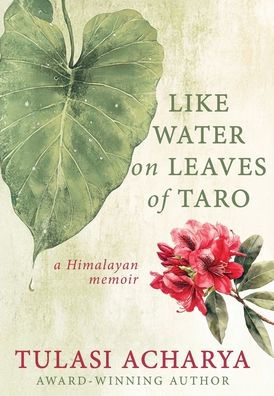
Like Water on Leaves of Taro: A Book Review by Candice Louisa Daquin
Dr. Acharya’s Like Water on Leaves of Taro is the quintessential immigrant’s dilemma, the urge to protect family and the necessity of earning an income abroad. He intimately understands; “The bitterness of reality. The truth often carries a harshness and bluntness that can be difficult to bear.” This journey is one we go on with the utmost sensitivity and yet, without any pretense otherwise. If it is possible, the way Dr. Acharya treats ‘suffering’ as a concept, is ultimately redemptive:
“I pictured the dwindling light of a lamp when the kerosene is about to run out. The brightness always intensified momentarily before fading away. The smile on my sasuraba’s face reminded me of that light. It made me reflect on the nature of change and how sickness can profoundly transform someone’s life.”
For any immigrant, like myself, this story is not only about the Pandemic and the resulting grief and survival of those left behind, but the pain of distance. Those who have not left their families behind, cannot easily understand the depth of loss and guilt that accompany this fracture and the intricacies of visa restrictions, that keep families apart. This memoir is about this loss of connection, the unnatural divide both physical and emotional and the resulting guilt in being apart, even as a dream is fulfilled for the sake of the whole family.
“I absorbed the room one more time, as if some mystery was hidden there, and my job was to uncover it. I thought about all those pictures slowly disappearing. The memories of those who passed away would continue to disappear as the colors in the photos faded.”
There is a depth here in seeing that bittersweet side of ‘success’ for the immigrant, when their family is so far away and suffering and everything is uncertain. In this, the memoir goes far beyond illness and Covid’s confines, and opens up into a universal story of loss and love. Of facing death in such an immediate way, there seem no words for it; but the author locates them:
“Cancer, they said, wasn’t just suffering. It was awakening. It stripped life down to its essence, forced honesty; exposed regrets, and called for grace. In illness, they found clarity – how to live better, kindlier, more intentionally.”
In addition, there are cultural roots so profound, we in the West have forgotten they existed, in the sincere duty one has to one’s parents-in-law, how becoming part of a family really means being part of it, and the emotions therein. The West doesn’t consider ‘duty’ in the way it once did, and whether right-or-wrong, duty is the backbone of the connected-family-tree in Dr. Acharya’s memoir. Both anchor and son to his wife’s family, the immense responsibility falls on his shoulders, whilst he is in America studying and teaching.
Dr. Acharya’s history studying women’s studies might partly account for his genuine sensitivity but it’s also likely his own mother is part-reason why he is able to identify and empathize so acutely with his wife’s pain. As he writes about his own mother: “Because of her (his mother) I became the man who now teachers as a university in America.” Moreover, Dr. Acharya’s understanding of ‘the riddle of palliative care’ (a chapter title) is astute, moving and without filter, yet at the same time, not unbearable enough to flinch and look away.
“Grief was a weight, but hope moved like light between the cracks.”
Interestingly the title doesn’t refer to water on a leaf, but a woman’s sweat fallen on a leaf, this memoir, though written by a man is as much about a woman’s sweat and struggle to give everything to her children, so that their generation do not have to struggle like hers did. Amongst these stories deeply infused with the colors, sounds and life of Nepal, are the descriptors of how two generations of Nepalese are the same, and yet so different.
“On paper-Kripa’s life read like a success story. With my job in the U.S – the dream destination for most Nepalis – and her work as a journalist, we had financial stability. We owned a house in Kathmandu, something many could only imagine. For a moment I believed in that life. That we had made it. But as I stood in the thick of grief, it all felt fragile.”
The combination of the natural world around him, alongside the grief within him, acts as a tension throughout, where family holds falling people together, and the weight of responsibility on one man’s shoulders, from America to Nepal, is explained, in the time of Covid. Ultimately the resilience and hopefulness remain as the final memoir of this story, where even in the weight of grief there is a humanity found in our human ritual that keeps us going, long after we believe we can, until we see the light again.
“Every culture has its strengths. Nepal, too, had its virtues – its deep-rooted traditions, its resilience, its sense of community.”
Candice Louisa Daquin is an editor and trauma-therapist. Daquin is Senior Editor with Indie Blu(e) Publishing, Editor with Raw Earth Ink and Queer Ink and editor with Life and Legends, Writers Resist and Tint Journal.