
& You Think It Ends: A Book Review by Nancy Murphy
& You Think It Ends, a Poetry Collection by Amy Small-McKinney (Glass Lyre Press, 2025)
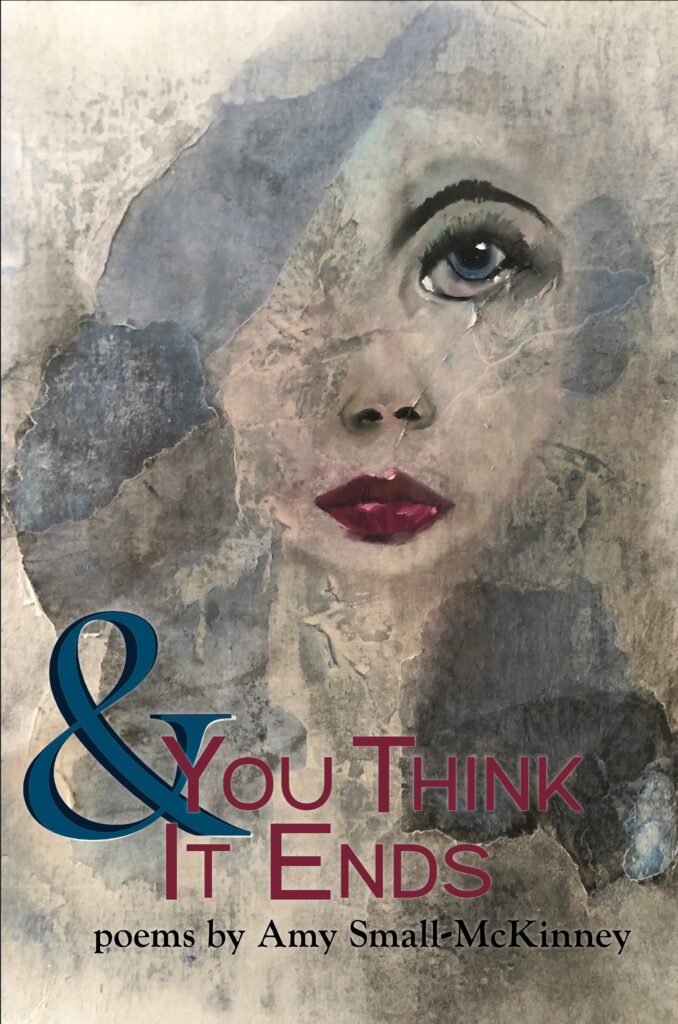
& You Think It Ends (Glass Lyre Press), the latest full length poetry collection from Amy Small-McKinney, astounds in its fierceness. The title of this book reads almost like a challenge or question. You can imagine her continuing, “Ha, you’re so wrong.” She seems to be saying that whatever you thought was over may not be. You don’t outgrow the ills of the world. You don’t outlive the wounds and trials of womanhood. You carry them with you, in your own body and in your memory. You relive them in the stories of other women, in your own family line and in strangers, here and around the world.
Her previous books gave us a window into the intimate and raw moments of illness and grief. She showed us a way through to the other side of these losses, forever altered yet with sparks of a spirit that would return. Indeed, she has returned. Perhaps facing the unthinkable has given her the inner strength, perspective and freedom to speak out about things long kept hidden. She does so on her own behalf, and on behalf of others who have suffered. In this way, her book is personal and political.
The opening standalone poem, “The enemy is fear,” masterfully lays out the trajectory of the book. It includes descriptions that jump off the page like, “Purple plants shock from brick walls.” What follows is foreboding: “Because I can’t forget / I move inside my body, a black umbrella.”
Later, these lines near the end of the poem capture what will be a recurring theme of renewal: “I need to become one body that means both fear and faith. / … / Let me walk with you. Invite in fear. Place it beside belief.”
The collection then breaks into four sections. In the first, “What else to do in this time,” the poems quickly step into painful topics. The poem “Here” starts with an epigraph about illegal abortionists. From the first lines, “How to describe fear as tracks in fresh snow / or as dogs let loose from a yard–,” a sense of danger descends. Then these lines:
I did not know what else to do in this time.
A body remembers stiff white sheets,
a long metal rod….
…
A young girl as torn paper.
Later, in a full circle moment, in the poem “Abortion, 1970/2022,” the author writes, “When my daughter tells me she will escort women to safety, / she holds my heart, this girl, this woman, who we both are, have become.”
In “This Is What I Remember,” she weaves a past personal story (“ His rage swaggering down a street / leaping onto my body / a shredded blouse”) with the horrors we read about in the paper every day and then with her own ancestral Polish war stories, ending with this arresting line that brings them together: “How we/our bodies/yearn for safe borders.”
In the second section of the book, titled “Here is a blanket,” family histories and coming of age poems are explored as well as modern day tragedies. Small-McKinney writes about a longing to know the ones who went before and for them to know and honor her daughter and their lineage.
In “The Story of Belonging,” this line sings: “This is my psalm: / An ancestor found her way.”
In the third section, “You must choose,” the author writes about the loss of her husband. The poem “Train Overflowing,” holds this aching passage:
I was a closed compartment
With pearls in my mouth
Wanting to breathe life back into an oyster shell
& I knew he was dying.
Further, in “How I Returned” this affirmation that echoes throughout the book: “I waited for you to return to me, / to my circle of not-seeing. Then I stopped, / welcomed home instead the insistent sparrow of myself.”
The fourth and final part of this collection is called, “It’s time It’s time It’s time.” The poems in this section celebrate the life of the body, despite of and because of its aging. At the same time, there is an urgency here that the section title conveys to finally live fully and embrace oneself. You can sense the relief that might come from speaking up for yourself, the empowerment that follows and touches everything. In “What I Remember:” the author makes a callback to the earlier poem “Here.” The line, “Today, I name myself: Seen & Remembered,” serves as an anthem or tagline for the whole book.
Small-McKinney is more than capable of traveling into sometimes dark territories and then imparting her well-earned knowledge back to us in these stunning and powerful poems of survival and evolution. Her honesty and bravery make this journey worth taking with her. We can only hope to grow alongside her.
_______
Nancy Murphy is the author of the poetry chapbook, “The Space Carved by the Sharpness of Your Absence” (Gyroscope Press). She was a winner in the Aurora Poetry contest in Winter 2020. Previous poetry publications include SWWIM, Sheila-Na-Gig, glassworks, The Ekphrastic Review, The Baltimore Review, Anacapa Review, and others. A long-time volunteer at WriteGirl, Nancy has mentored teens at writing workshops and in the juvenile detention system. www.nancymurphywriter.com
