
To Sylvia: A Book Review by Candice Lousia Daquin
To Sylvia, a Poetry Collection by Anushka Mitra (WissenMonk Publications, 2025)
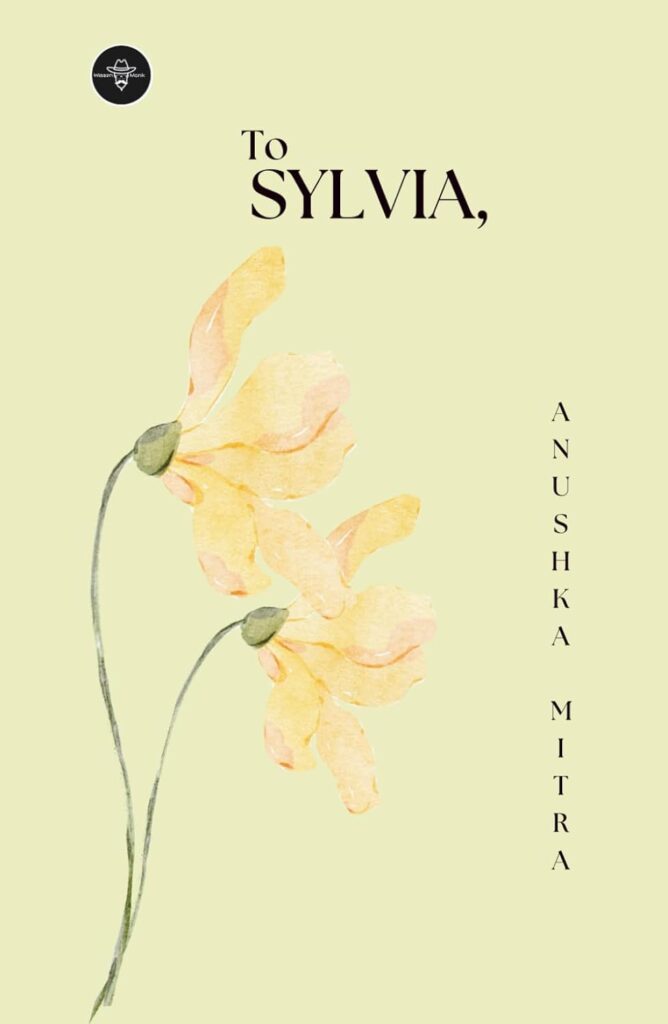
In this slim volume of poetry influenced by its eponymous heroine, poet Anushka Mitra directly questions the very subjects Sylvia Plath did, through an echo refrain of Plath’s considerations and Anushka’s own forthright way of expressing herself. In the opening poem Sylvia, she says:
how sad does one have to be
to make rhymes out of pain
Anushka reflects on what it takes to write poetry, and whether for some, suicide or the impulse to die, is part-and-parcel of this process. In the poem My Love is Not a Red, Red Rose, there is a play on the irony of that, a feminist twist, alongside punchy lines like: The tiring months cried inside my chest. Anushka’s courage to reveal deeper emotions is evidenced throughout, for example when she discusses what yearning is:
A language that speaks in the deadness of
mornings and the frown between two eyebrows, one
that our tongue must not understand.
There is philosophy in the psyche within this writing. An acute ability to observe at a micro-level, the machinations of human-nature, combined with the natural world and its elements such as in the poem The Coming of Spring:
you can see the streets
intersect
and part ways like the people who walk it every day.
The blending of mundane everyday (combing hair) with the bristling sexism being described and the writer’s fierceness in rebuke. These are done ‘slanted’ meaning not directly, but through a mixture of metaphor, descriptor and observation, much as Emily Dickenson was known for:
He asks me why I want the job,
And where I am from.
I have walked the intersections.
I do not know.
Let us not ignore, this is an Indian poet, writing in English, bringing to the English language, the effusive beauty that is India and her landscape. Anushka evidences her deep commitment and awareness of literature, as every poem evidences, such as the poem The Lovers, where she perfectly describes the existential isolation of modern life, that feeling of impermanence and not belonging. She talks of ‘no lack of loneliness’ with a fresh-faced candor that doesn’t smack of self-pity so much as her generations reality and ability to speak truths. The consideration of love isn’t pretty, or packaged or ‘careful’ – it’s brutal, challenging and honest:
Here, I flit through life,
from alley to alley, harboring misfortunes
and family of marble statues, diamond timepieces, cash
and card and what not
and no skin, no warmth, no arms to belong to.
Creature of habit, creature of privilege,
creature of un-love
Even if the poet didn’t use Plath as her diving board, these poems have legs that stand on their own. The pervading influence simply strengthens their existence. In one of the most powerful poems Grief, My Grief, Anushka annunciates something almost impossible to express, the idea that grief was once universal, become so personalized, it is that internalization of grief that wicks heaviest, causing the most harm. The descriptions are as lovely as they are violent and painful, with lines like:
It is the stained corner of
my childhood home. Ugly, but a necessary ornament in
the familiarity of life.
There is a realization without filter, of the dehumanization of modern-life, how grief can become an element within us, even as it doesn’t destroy us, there is a sense of it taking us over, changing us in ways that are so intricate and yet, unseen on the outside:
It does not shatter me. It beats me
against the countertop, gently, an amateur cook trying to
peel open a hard-boiled egg. I do not spill.
Understanding the complexities of grief is no small feat, neither the art within the mundane, which Plath was known for observing and Anushka inherently grasps. It is worth noting, she doesn’t replicate, or repeat, she walks on the stage set by Plath, creating her own diorama, an original entity, quite apart. In the poem The Pretense of Fidelity, Anushka places words so carefully, you’d think she had invented a new language:
And on a Sunday, your lost morality drains
Through the kitchen sink
Again, this is as artful a Plath’s alacrity with form and meaning. Plath wrote confessional poetry with the un-structured-fluidity of a natural poet. Anushka’s writing possesses the same candor with a blunt edge, that lends the same ultimate gravitas, with lines like: I want to choke on the love that I’ve lived for. This temple to love and its failures, is a collection many of us will intensely relate to; the temporal passion brewing behind each testament, becomes hypnotic in its close surrealist after-taste with lines like: I lose my language in the allegories of your tongue (The First Kiss).
The idea of inhabiting another, of being a cigarette in someone’s mouth, such metaphor and visualizations are woven, repeatedly, into a trance-like style of writing, as graceful and methodical as writing can be:
I am dressed in my longing for you, in white button-ups
that drip onto me like your absence would. (The Illicit Affair (3 of 3)
Where Anushka talks of: The holy palace of simulations, chairs of delusion, in her earlier poem Social Media, she later completes the thought in undoubtedly the most powerful poem A House of My Own. It is both feminist confessional, and a highly evocative response to the position of girls and women, in their families of origin and beyond.
But the girl they killed
Is the girl I birth
I birth a House of my Own.
I birth a door they keep shut.
_____
Candice Louisa Daquin is an editor and trauma-therapist. Daquin is Senior Editor with Indie Blu(e) Publishing, Editor with Raw Earth Ink and Queer Ink and editor with Life and Legends, Writers Resist and Tint Journal.
