
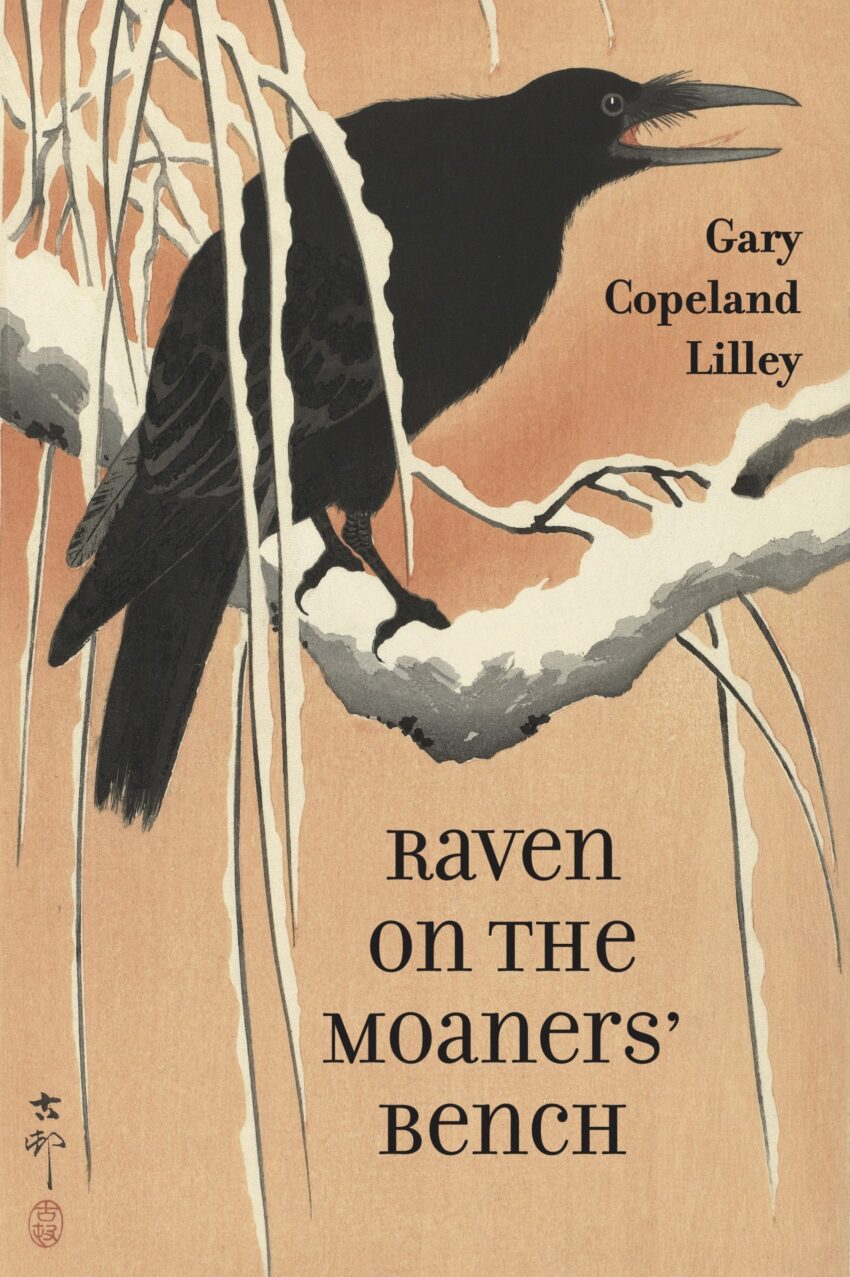
Raven On The Moaners’ Bench: A review by Richard Meadows
Raven On The Moaners’ Bench (Four Way Books,2025) a poetry collection by Gary Copeland Lilley
In Gary Copeland Lilley’s latest collection, Raven On The Moaners’ Bench (Four Way Books, 2025), muddy waters are made clear through powerful written acts of redemption. These are not white dove paens to peace and praise poems, but stark raven poems of pain and a dark abyss where the boon, ultimately, is one of forgiveness. Page after page, I felt carried through the Black experience in America by way of family, water, alcohol, violence, abuse, scripture, and music.
Many of the poems in Raven On The Moaners’ Bench are poems of place, but also poems of faraway or the dream of getting there. In “What It’s Like to Live With a Lack of Shade,” we see how getting stuck in a place “…can kill you./And not even eventually but/the way a nothing- there-for-you/can burrow into you and/dark-you-in like a secret eclipse.” In “Hunger,” one of the faraway places that the poet migrates to is the Northwest, where he speaks to his brother Jeff, who has also wandered in his own hunger to other places, “where hunger lives/in its hallowed privacy of killing and being/killed in unwitnessed silence.” In the opening section in particular, the poet gives voice to this “unwitnessed silence” through poems about his “dead younger brother” who is painfully rendered, “the dazed man/my dead younger brother is.” Before Jeff crosses over during the pandemic, his suffering is laid bare in these pages. The closing poem of this section, “Raven on My Fence the Day of My Brother Jeff’s Memorial” offers a balm:
What message does the raven bring
from the spirit world? His arrival
brings me comfort; souls travel on wings,
magic from the world where Jeff is now.
In the central section, Da/Loco/Mojo (What Can Drive You Crazy), one finds music and image dancing on the page as in “(This Is) Belvidere, NC” where speaking of the poet’s mother’s “harvest-gold GrandMarquis” we find:
the boy down the road who cuts her grass
every Saturday makes sure her sedan
looks free from sin on Sundays—
he rubs that metal until it squeals
like Gabriel’s saxophone/and it’s a holy transformation, parked
in sanctified sunlight.”
“Surviving Through the Sabbaths” begins, “God is our banjo-playing blues man,/our theoretical back-pocket bottle—/in the cold hard rain we will rise/warm and dry…” Though many of these poems dwell in the darkness of ravens’ wings, they also offer the promise of flight and song. In “Ars Poetica” Lilley honors the craft of poetry and his own unique voice with “Language chock full of music, a dance/of words I am just hearing/in the very moment I presently reside.” The title poem of this section ends, “…the power of the mouth,/that the world’s voracious appetite/is not to taste us/but to swallow us whole” carries the potency of words forward. In “Hankering” music continues to pervade:
I’d left the radio on and J.D. McCloud
is playing a Mississippi flood song—
you know, the river that floods every year
under heavy rain. There is that bluesy
threat of landslides and falling trees,
the water that always wins.
Even as I write this review in the Pacific Northwest, there is an atmospheric river that has brought major flooding to the region, which is further evidence of “the water that always wins.”
Section three Wife. Beater consists of a twenty-page serial poem where the brutal silences that domestic violence keeps rise to the surface:
Everyone that knew my father knew
he beat his wife—us children, we
were ashamed, my aunt and the uncles,
my grandmother—they all loved him,
even though ashamed.
In the concluding Coda, I find a hint of the forgiveness I spoke of in the introduction of this review:
He shook my hand on it and called me son
And I told him I thought that was a bit much.
But from that day forward he continued
To address me as son. And this became our truce.
I found myself haunted long after closing the book. I feel this may be Gary’s masterpiece, so far, until he returns, once again, to that blank page and begins to moan, bleeding the ink of blackness into light.
Gary Copeland Lilley lives in the Pacific Northwest and is the author of nine books of poetry, including The Subsequent Blues, Alpha Zulu, and The Bushman’s Medicine Show. Lilley earned an MFA in Poetry from Warren Wilson College. He teaches in the Western Colorado University Creative Writing MFA program and serves as the Artistic Director of the Port Townsend Writers Conference in Washington state. Lilley is a Cave Canem Fellow.
Richard Meadows is a nature-loving poet and adventurer who loves music-driven road trips. He is a hiker, backpacker, kayaker, and bicycle rider who loves being outdoors. Richard holds an MFA in Creative Writing of Poetry from Western Colorado University in Gunnison, Colorado, and lives in Port Townsend, Washington.
