
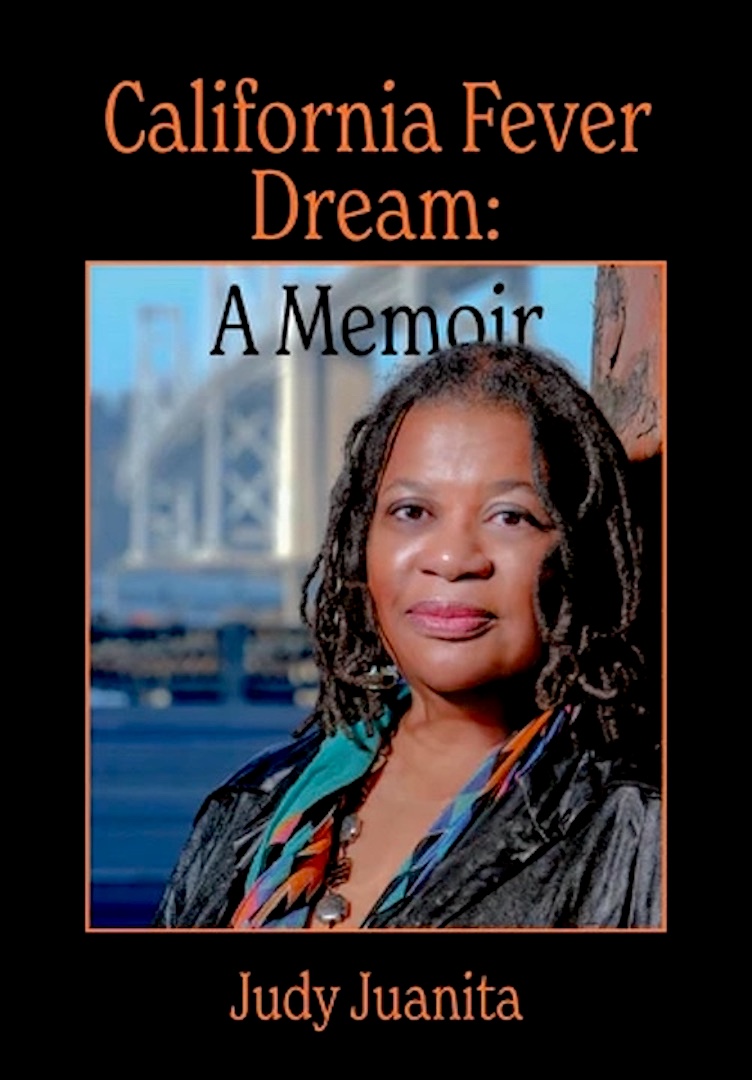
California Fever Dream, a book review by Candice Louisa Daquin
California Fever Dream (Willow Books) a memoir by Dr. Judy Juanita
In California Fever Dream, a memoir, Dr. Judy Juanita possesses a rarefied ability of a memoir writer to reach outside her own Black feminist experiences and touch on universal humanism without neglecting her original focus. Juanita’s previous work, Manhattan my ass, you’re in Oakland (winner of the American Book Award) exposed the history of Oakland prior to Blacks being socially driven out, and in her latest memoir, she weaves together stories that relate to her life’s activism and observations, in an unpretentious, deeply connective voice.
An entire category of people is being reduced to caricature. The more vulnerable we are, the easier to target.
Published by Willow Books (a division of Aquarius Press, the publishers of respected anthology Black Fire This Time), Juanita’s memoir is both a story of her life and of many of us, caught in the crosshairs of identity, stereotypes and oppression: “Trayvon (Martin) was at risk because he didn’t know how to cower, a posture that my generation destroyed.” Cracking open her emergence from obscurity to preeminent author, professor, playwright and activist, blended against detailed recollections of specific experiences that speak to the time-and-place as well as social milieu.
“Let the white kids lead a palace revolt. Let the white man be divided. Divided he falls, united we stand. When the man closes ranks is when we should be alarmed. That’s when he’s at his deadliest.”
Humility has a role too: “It’s taken me a long time to understand that self-disparagement is a form of humility and not a mark of low self-esteem.” Whether this is influenced by Juanita’s personal Buddhism or the result of “60 years in the making,” as the back cover attests, truth breathes without convolution here and as she points out: “the feat of aging gives one that Yeatsian right to write the story.” Rage isn’t the sole voice at the table, which opens a bare-bone discussion, where; “The ideals of my twenties were eclipsed by real life.” As she says of being a Black Panther, she actuated real change: “I believe we helped avert large-scale urban warfare in my hometown, Oakland.”
Localized (and universalized) messages are relevant then, now and into the future. Juanita as a wife, mother and then divorced single parent, is also realistically written, where she; “had chosen to be an observer not an exclaimer. Why? It had to do with fear, hostility and confrontation. The party confronted the most powerful and the deadliest force in the civilized world, the U.S. government.” Furthermore, the shadow-side of good intentions, such as sexual exploitation which is currently in the news today with rape-allegations posthumously against Cesar Chavez, the Mexican American labor leader:
Future activists need to see the fuller picture. […] Women’s sexuality, childbirths and abortions, and sexual politics were integral parts […] However, there were also tensions and debates around the value and role of women’s sexual exploits within the movements […] I read Che Guevara’s biography […] saw the exact same phenomenon. Why is it so hard to face that using young women and their sexual vulnerability […] is key to everything political?
Juanita articulates the hypocrisy within the movements as well as the social-value and how it was and is, almost impossible to marry the two at times, such as a woman wearing a short dress being chastised in front of hundreds by Minister Louis Farrakhan:
I felt her humiliation. It reminded me of the divide in the sixties between black cultural nationalists and the Black Panther Party. Each had a code and woe to those who violated it.
The ability to critique without devaluing the movement(s) as well as through a feminist lens, and see the historic prejudices (anti-gay, anti-woman) of some, is not explored as often by male writers with similar backgrounds. Juanita’s truth represents many of our own life’s truth and it’s in that, we feel the greatest messages of this necessary memoir:
The successful women artists I encountered were hardworking, self-sacrificing, generous, often defiantly unhappy and did their own shitwork.
It’s a fascinating, bluntly honest account of what enduringly matters most and what’s still not fixed in American society:
We ain’t going back. We have to keep it moving. […] This is about color in America. This is about dark skin. This is about the stigmata of brown skin. It’s not erasable. When we walk in a store, theater, park, our history walks in with us, alongside us, in front of us. It introduces us. It introduces us. Not our peacefulness or our politeness or our profession. We are at war. Not with people, with the mind of ignorance, hate, indifference, callousness, cruelty. […] We can’t reverse history. We are free but we have to fight with all our might to protect that hard won freedom.
Juanita’s writing has pathos, gravitas, humor, emotion and an almost photogenic recollection of experiences that add to the neglected canon of Black feminism, African American history and beyond. When I say beyond, I mean throughout all concepts of identity as a Black person in a largely white America. Juanita tackles touchy subjects of overcompensation, white guilt (and thus, white activism that unintentionally fouls the Black message) and her grasp of the nuance of these considerations is intricate and illuminating:
Maybe you see it as overcompensation. When you look outwardly, unless you look in a mirror, you can’t see yourself. You can’t see if you’re skinny or fat or white or black. You see the people around you. Whatever they are, that’s what you are.
Judy Juanita articulates a phenomenon that psychologists are still grappling with decades later, something most people of color experience regularly, translating outward to women, immigrants, and LGBTIQQ+ where in this memoir, the concept of identity is identified so acutely it’s staggering in its social prescience:
Our experience in the party helped us envision a viability in revitalizing and connecting to our community versus fleeing into the mainstream, corporate America or the professions as a distanced, glancing downward teacher or social worker. […] we became aware of the class contradictions in the American dream.
Candice Louisa Daquin is Associate Editor with Life & Legends, Managing Editor for Lit Fox Books (Austin, TX), Reviews Editor for Austin Poetry Review, and Poetry Editor with Writers Resist and Parcham. Daquin is also Consultant Editor for Raw Earth Ink and co-judge of The Northwind Writing Award. www.candicelouisadaquin.com
